
Table of Contents
- Why Batch-Specific Documentation Separates Good Research Peptides From Bad
- Peptide Certificate of Analysis Interpretation: What Each Section Actually Tells You
- HPLC and Mass Spectrometry for Peptides: How Independent Labs Verify Identity
- How to Verify Peptide Purity Without a Laboratory of Your Own
- Packaging, Storage, and Handling: Quality Signals Beyond the Certificate
- Supplier Transparency: What a Dependable Research Peptide Source Looks Like
- Frequently Asked Questions
Last Updated: September 12, 2026
Why Batch-Specific Documentation Separates Good Research Peptides From Bad
The clearest sign of high quality research peptides is batch-specific documentation: a Certificate of Analysis that carries a unique batch number, a testing date, results traceable to the specific batch or lot from which the supplied material originated.. Suppliers who test in bulk and reuse a single certificate across months of stock are asking you to trust a document that describes nothing you actually received.
This guide from VOREVIA covers how to read that paperwork properly, how independent laboratories confirm identity, and what packaging and supplier behaviour reveal when the certificate looks fine but something feels off.
Here’s the distinction most buyers miss. A generic certificate proves someone, somewhere, tested something. A batch-specific certificate proves this material was tested, on a known date, by a named method. Only the second one lets you reproduce your own results later.
Peptide Certificate of Analysis Interpretation: What Each Section Actually Tells You
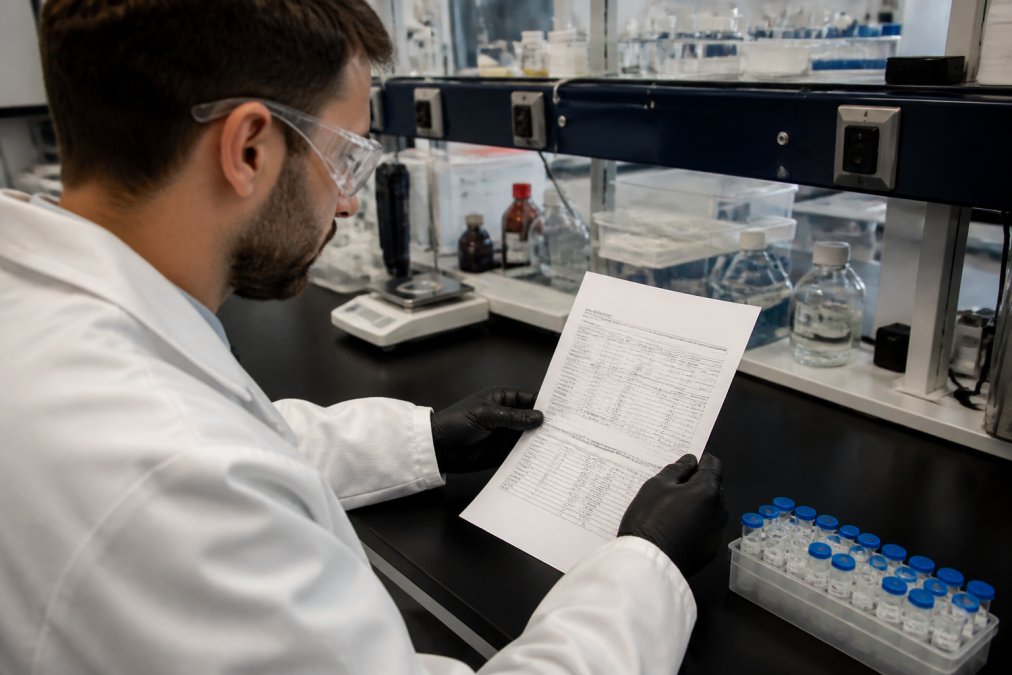
Peptide certificate of analysis interpretation comes down to three verifiable numbers: identity, purity, and quantity. Everything else on the page is context. If those three are missing, vague, or copied across batches, the document has no analytical value.
Identity, Purity, and Quantity: The Three Numbers That Matter
Identity is confirmed by mass spectrometry, which measures molecular weight. The reported mass should match the theoretical mass of the peptide, typically within a tight tolerance. A certificate quoting identity without a method name is a claim, not a result.
Purity is expressed as a percentage from chromatographic analysis, usually HPLC. It tells you what proportion of the material is the target peptide rather than related impurities.
Quantity is the net peptide content, not the gross weight of the vial. A vial labelled 5mg may contain considerably less actual peptide once counter-ions and moisture are accounted for (PubMed). Reputable documentation states which figure it is reporting.
Red Flags in a COA: Watered-Down Results and Copy-Paste Batches
The most common problem is not a forged certificate. It is a real certificate applied to the wrong batch.
Look for these warning signs:
- The same certificate number appears across orders placed weeks apart
- Chromatograms are absent, low-resolution, or identical between products
- Purity is quoted as a round number with no decimal places and no method
- The testing date predates the manufacturing date
- Spectral data is described but not shown
HPLC and Mass Spectrometry for Peptides: How Independent Labs Verify Identity
HPLC and mass spectrometry for peptides work as a pair because each covers the other’s blind spot. Chromatography separates and quantifies; mass spectrometry confirms what the separated peak actually is. A purity figure without a mass confirmation tells you the material is clean but not that it is the right compound.
High-performance liquid chromatography (HPLC) is an analytical technique that separates the components of a mixture by passing it through a column and measuring how long each component takes to elute (peer-reviewed research). For peptides, the main peak is the target compound and the surrounding peaks are impurities, truncations, or oxidation products.
Mass spectrometry (MS) ionises the sample and measures the mass-to-charge ratio of the resulting ions (PubMed). For a peptide, the observed molecular weight should match the theoretical value calculated from its sequence.
Independent analytical verification provides an additional layer of assurance by having material assessed by a laboratory separate from the supplier. This complements manufacturer and supplier quality controls by providing independently generated analytical results. VOREVIA incorporates independent analytical verification into its quality assurance process rather than relying solely on supplier-provided documentation.
How to Verify Peptide Purity Without a Laboratory of Your Own
You can verify peptide purity without running your own assays by cross-checking documentation, requesting raw data, and using simple physical observation. None of these replaces instrumental analysis, but together they filter out most unreliable suppliers before you commit budget.
Start with the paperwork audit:
- Confirm the batch number on the certificate matches the batch number on the vial
- Check the testing date falls after the manufacturing date
- Verify the laboratory named on the certificate actually exists and offers the method quoted
- Request the full chromatogram and mass spectrum, not the summary
- Compare the reported molecular weight against the theoretical value for the sequence
Then the physical check. Lyophilised peptide should arrive as a uniform, free-flowing powder or cake. Discolouration, clumping, or a strong odour suggests degradation or contamination. Reconstituted material should dissolve clearly; persistent cloudiness is a warning sign.
Packaging, Storage, and Handling: Quality Signals Beyond the Certificate
Appropriate packaging, storage and transport conditions help protect research materials between testing and delivery. Requirements can vary according to the compound and its specified storage conditions, so handling should be appropriate to the individual material and supported by clear storage guidance.
What to check on arrival:
Signal | What Good Looks Like | What It Suggests If Wrong |
|---|---|---|
Vial seal | Crimped, intact, tamper-evident | Compromised sterility and possible moisture ingress |
Desiccant | Present and unexpired | Moisture uptake during transit |
Transport conditions | Appropriate packaging and transport conditions consistent with the material’s specified requirements. | Potential exposure to unsuitable transport conditions. |
Labelling | Batch number, sequence, mass, storage conditions | Poor traceability, hard to audit |
Outer packaging | Discreet, undamaged, correctly addressed | Handling problems in fulfilment |
Storage requirements vary between research materials and should follow the conditions specified for the individual product. Temperature, light exposure, moisture and other environmental factors can affect material stability, making clear storage guidance an important part of responsible research-product documentation.
Supplier Transparency: What a Dependable Research Peptide Source Looks Like
A dependable research peptide source is one that volunteers information before you ask for it. Transparency is not a marketing claim; it is a pattern of behaviour you can test with two emails and a documentation request.
What separates a transparent supplier from a well-worded one:
- Batch-specific certificates issued per lot, not recycled across the catalogue
- Independent laboratory testing, with the laboratory named and contactable
- Clear information about product sourcing and quality controls, supported by appropriate documentation where available.
- Responsible product information that treats buyers as researchers rather than consumers
- Straightforward procurement, including documentation suitable for institutional review
On that last point, laboratories adding a new supplier often need paperwork for procurement teams and vendor approval processes. Ask upfront what documentation is available for institutional onboarding, because switching suppliers late in a project is far more disruptive than checking credentials early.
VOREVIA supplies research peptides supported by batch-specific documentation and independent analytical verification. Our quality assurance approach is designed to provide clear traceability between supplied material and its supporting analytical results, helping researchers make informed decisions about the materials used in their work.
Frequently Asked Questions
What documentation should accompany high-quality research peptides?
A batch-specific Certificate of Analysis is the starting point. It should state the peptide name, batch number, molecular weight, purity percentage from HPLC, and identity confirmation from mass spectrometry. Look for the testing laboratory’s name and a report reference you can verify. High-quality research peptides also arrive with storage guidance, a clear label matching the COA batch, and packaging that protects the material during transit.
How do I interpret a Certificate of Analysis for peptides?
When reviewing a Certificate of Analysis, consider the reported identity, purity and quantity alongside the analytical methods used. For peptide analysis, techniques such as HPLC and mass spectrometry can provide complementary information about purity and identity. The batch or lot reference on the supporting documentation should also correspond with the supplied material.
What are the common indicators of low-quality or impure peptides?
Warning signs include COAs with no batch number, purity figures that never vary between orders, missing mass spectrometry data, and labels that do not match the certificate. Visually, degraded material may appear discoloured or clumped, though appearance alone is unreliable. A supplier who cannot explain how to verify peptide purity independently, or who avoids questions about manufacturing origin, is a risk.
Why is independent analytical verification critical for peptide research?
In-house testing tells you what a supplier claims about their own product. Independent verification by a separate laboratory confirms identity and purity against a reference standard. For reproducible experiments, you need to know the material in the vial matches the specification on paper. Without that link, any unexpected result becomes impossible to interpret, and you cannot tell whether the compound or your protocol caused it.