

Table of Contents
- Why Independent Testing Matters in Peptide Procurement
- Peptide Purity Verification Methods You Can Trust
- The Importance of a Certificate of Analysis for Peptides
- How to Interpret Peptide HPLC and Mass Spectrometry Results
- Selecting Independent Testing Laboratories in the UK
- Common Challenges in Peptide Procurement and How to Solve Them
- Frequently Asked Questions
Last Updated: September 21, 2026
Why Independent Testing Matters in Peptide Procurement
The role of independent testing in peptide procurement is the difference between research you can defend and research you can’t. Independent testing is the practice of sending a sample from a finished peptide batch to a laboratory with no commercial relationship to the supplier, so that purity and identity are confirmed by a party with nothing to gain from the result. Every batch is verified this way before it enters the catalogue, because self-reported quality means very little when a supplier controls both the sample and the result.
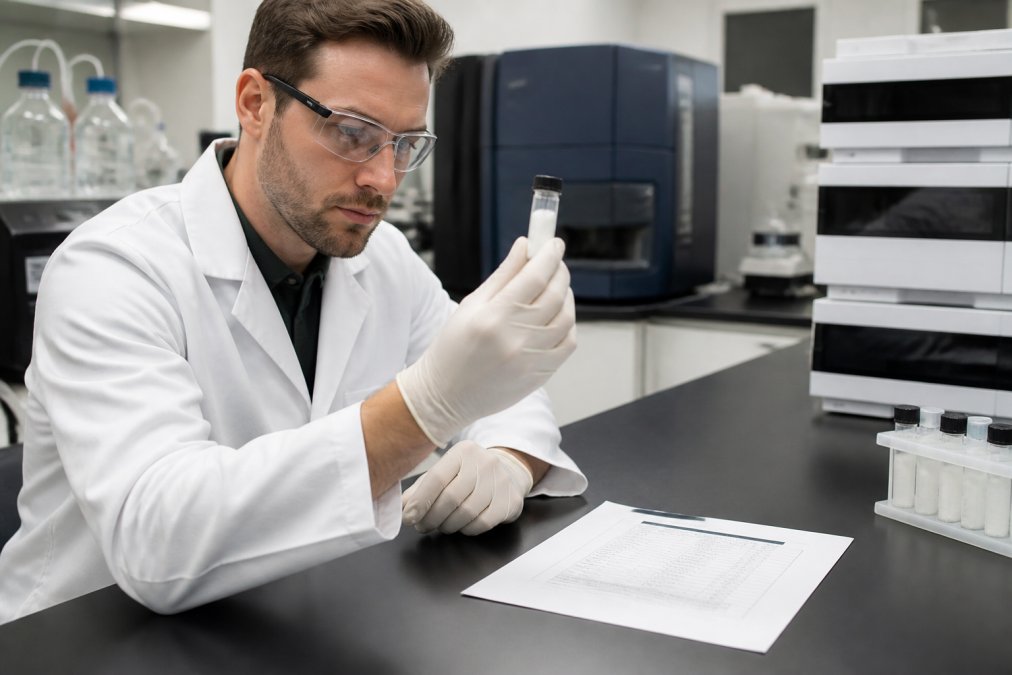
Here’s the uncomfortable part most buyers learn late. A supplier’s own internal analysis is not verification. It is marketing with a chromatogram attached. When the same organisation synthesises, tests and reports, there is no independent check on any of those three steps, and a researcher downstream has no way to tell a genuine result from a favourable one.
That gap is exactly what third-party analysis closes. The guidance from the Medicines and Healthcare products Regulatory Agency on laboratory testing and quality sets out why analytical evidence matters in any regulated supply chain, and the principle carries straight over to research materials.
For procurement teams, the case is practical rather than philosophical. Reproducibility depends on knowing what was in the vial, not what the label claimed.
Independent testing exists to remove the supplier from the verification loop. If the same party makes the product and signs off on its quality, you are trusting a claim, not checking one.
Peptide Purity Verification Methods You Can Trust
Two analytical techniques carry almost all the weight in peptide quality control: HPLC for purity and mass spectrometry for identity. Together they answer the two questions that matter most, which are how much of the material is the target peptide and whether that material is actually the compound named on the label.
A single technique is rarely enough. Purity without identity tells you a sample is clean but not what it is. Identity without purity confirms the right molecule is present, possibly alongside a substantial amount of something else. Serious peptide purity verification methods always pair the two.
HPLC: The Gold Standard for Purity
High-performance liquid chromatography separates the components of a sample and reports each as a proportion of the total. In peptide work, the main peak represents the target compound, and the percentage area under that peak is the purity figure quoted on a certificate.
What most guides miss is that the number is only as good as the method behind it. Wavelength, column type, gradient and integration settings all shape the result, and a certificate that omits them is difficult to assess. A well-documented HPLC report shows the chromatogram itself, not just a headline percentage.
Mass Spectrometry: Confirming Molecular Identity
Mass spectrometry measures the mass-to-charge ratio of the molecules in a sample, producing a spectrum that acts as a molecular fingerprint. For a peptide, the observed mass should match the theoretical mass of the intended sequence within a tight tolerance.
This is where identity gets settled. A sample can be extremely pure and still be the wrong compound, and only mass data catches that. When the observed and calculated masses agree, the researcher has confirmation that the material is what it claims to be.
The Importance of a Certificate of Analysis for Peptides
The importance of a certificate of analysis for peptides comes down to traceability. A COA is the document that ties a specific batch number to specific analytical results, and without it a purity claim is just an assertion with no batch behind it.
Batch specificity is the point. A generic COA, one that describes a product line rather than a single lot, tells a researcher nothing about the vial in their hand. The document should name the batch, the date of analysis, the methods used and the results obtained, so that anyone reviewing the work later can trace it back.
What a Compliant COA Must Contain
A usable certificate typically includes the following:
- Supplier name and batch or lot number
- Date of analysis and the testing laboratory’s identity
- HPLC chromatogram with purity percentage and method conditions
- Mass spectrometry spectrum with observed and theoretical mass
- Appearance and physical form of the material
- Storage and handling instructions
If a supplier cannot or will not supply a batch-matched document on request, that is a signal worth taking seriously. Procurement decisions rest on evidence, and a COA is the minimum evidence a research buyer should expect.
A COA that lists no batch number, no testing laboratory and no raw data is not verification. Treat it as a product description, and expect to have no recourse if the material underperforms.
How to Interpret Peptide HPLC and Mass Spectrometry Results
Reading analytical data is a skill, and it is the one that separates confident procurement from guesswork. How to interpret peptide HPLC and mass spectrometry results comes down to checking three things: whether the numbers are internally consistent, whether the methods are disclosed, and whether the results match the specification for that compound.
On the HPLC side, look for a single dominant peak with a clearly stated purity figure. A chromatogram cluttered with secondary peaks suggests impurities or degradation, and the purity percentage should reflect that honestly rather than being rounded up. The retention time and method conditions should be stated so the result can be understood in context.
Mass data should show the expected molecular ion and, where relevant, the fragmentation pattern. The observed mass must sit within an acceptable tolerance of the theoretical value. Anything presented without units, tolerance or reference values is not interpretable, and a certificate that cannot be interpreted is not doing its job.
| What to Check | Where to Look | Red Flag |
|---|---|---|
| Purity percentage | HPLC report | No chromatogram shown |
| Molecular identity | Mass spectrum | No theoretical mass given |
| Batch traceability | COA header | No lot number listed |
| Method detail | Analytical notes | Conditions omitted |
| Testing party | Laboratory name | Internal testing only |
That table is a quick triage tool. If two or more rows raise a flag, ask the supplier for the underlying data before committing to a purchase.
Selecting Independent Testing Laboratories in the UK
Choosing a testing laboratory is a procurement decision in its own right, and it deserves the same scrutiny as choosing a supplier. The laboratory must be genuinely independent of the supplier, appropriately accredited, and able to demonstrate competence in peptide analysis specifically.
Accreditation is the first filter. In the UK, laboratories are assessed against recognised quality standards, and the United Kingdom Accreditation Service directory of accredited laboratories allows buyers to confirm whether a facility holds relevant accreditation for the testing it performs. Accreditation is not a guarantee of a correct result, but it does indicate that the laboratory operates under externally audited procedures.
Beyond accreditation, look at scope. A laboratory that mainly handles environmental or food samples may not have the method development experience that peptide analysis demands. Ask what reference standards are used, how instruments are calibrated, and whether the laboratory reports raw data alongside conclusions. A facility that answers those questions directly is usually the one worth working with.
Ask a prospective laboratory how it handles a sample that fails specification. A lab that reports failures plainly, and in the same format as passes, is behaving independently. One that only ever returns favourable results is not testing, it is validating.
Common Challenges in Peptide Procurement and How to Solve Them
Most procurement problems trace back to information gaps rather than bad intentions. The supplier knows more about the batch than the buyer does, and that asymmetry creates the risk.
The first challenge is opaque sourcing. Many suppliers describe materials as domestically produced without offering anything verifiable. The fix is to ask for manufacturing and testing documentation tied to the batch, and to treat vague answers as a genuine answer.
The second is inconsistent quality between batches. A researcher who validates a method against one lot and then receives a different lot with different characteristics has to revalidate, which costs time and undermines comparability. Batch-specific documentation solves this by letting the buyer confirm each lot independently.
The third is the sheer difficulty of interpreting analytical data without a chemistry background.
Frequently Asked Questions
Why is independent testing critical for research peptides?
Independent testing is essential because it provides an unbiased confirmation of a peptide’s identity, purity and quantity. Without it, researchers cannot be certain that a product matches its label or is free from synthesis by-products. For peptide procurement, this means relying on third-party laboratories rather than a supplier’s internal claims. Independent verification supports reproducibility and helps prevent wasted time, resources and experimental variability.
What analytical methods are used to verify peptide purity?
The two primary methods are High-Performance Liquid Chromatography (HPLC) and Mass Spectrometry (MS). HPLC separates and quantifies the peptide, producing a purity percentage based on peak area. MS confirms the molecular weight, ensuring the correct sequence is present. Together, these peptide purity verification methods provide a robust picture of both purity and identity, which is why reputable suppliers include both in their batch documentation.
What should researchers look for in a certificate of analysis?
A valid Certificate of Analysis (COA) should include the batch number, test date, analytical methods used, and the specific results for purity, identity and quantity. It should be issued by an independent laboratory, not the supplier itself. Look for a chromatogram with a clear main peak and a mass spectrum matching the expected molecular weight. This documentation is central to peptide procurement because it lets you trace a specific batch back to its test data.
How does batch-specific documentation improve research reproducibility?
Batch-specific documentation links each vial to its own analytical results, so you know exactly what was tested. If a future experiment uses a different batch, you can compare the COAs to check for consistency. This traceability reduces the risk of unnoticed variability between batches, which is a common source of irreproducible results. For labs comparing suppliers, batch-level data is a practical way to assess quality control over time.