

Table of Contents
- What Drives Retatrutide Price in the UK
- Retatrutide Price Per Mg: Breaking Down the Numbers
- Retatrutide Certificate of Analysis: What You’re Paying For
- Retatrutide Availability: UK Stock and Delivery Timelines
- Retatrutide vs Cagrilintide: Price and Specification Compared
- Evaluating Quality and Value Before You Buy
- Conclusion
- Frequently Asked Questions
Last Updated: 9 October 2026
What Drives Retatrutide Price in the UK
Retatrutide price in the UK reflects a mix of synthesis complexity, independent analytical testing, batch documentation, and domestic stockholding. VOREVIA supplies research-grade Retatrutide 20mg to laboratories across the UK, and pricing is set by what it genuinely costs to verify and hold stock rather than by headline vial figures alone.
Retatrutide is a triple-agonist research peptide studied for its interaction with GLP-1, GIP, and glucagon receptors. That complexity matters commercially. A longer synthesis route, more purification steps, and stricter identity confirmation all push cost upward before a single vial reaches a shelf.
Three factors separate serious suppliers from the rest:
- Synthesis and purification route – more steps mean higher cost but tighter impurity profiles
- Independent analytical verification – third-party testing adds cost that in-house checks avoid
- Domestic stockholding – UK-held inventory removes customs delays but carries storage overhead
Retatrutide price is a quality signal, not just a number. A suspiciously low figure usually means testing, documentation, or storage has been cut somewhere in the chain.
Retatrutide Price Per Mg: Breaking Down the Numbers
Retatrutide price per mg is the only figure that lets researchers compare suppliers fairly, because vial sizes vary so widely. A 20mg vial and a 10mg vial cannot be judged on sticker price alone.
Dividing total vial cost by milligram content gives a true unit rate. That rate then sits alongside purity percentage and batch documentation to show real value.
Why Cost Per Mg Matters More Than Vial Price
A larger vial almost always looks cheaper per unit, but only if purity holds. A 20mg vial at 98% purity delivers more usable material than a 10mg vial at 90%, even when the smaller vial costs less upfront.
Researchers should calculate cost per mg, then divide again by purity to reach cost per mg of usable peptide. That final figure is the one worth comparing.
| Comparison Basis | What It Shows | Why It Matters |
|---|---|---|
| Vial price | Headline cost only | Misleading across different vial sizes |
| Cost per mg | Unit rate across sizes | Enables fair supplier comparison |
| Cost per mg at purity | Usable material rate | Reveals true research value |
| Cost per verified batch | Documentation included | Reflects traceability and reproducibility |
Ask for the batch-specific Certificate of Analysis before comparing any two quotes. A low cost per mg means nothing if the purity figure cannot be independently verified.
Retatrutide Certificate of Analysis: What You’re Paying For
A Retatrutide certificate of analysis is the document that proves identity, purity, and quantity for a specific batch. It is the single most important quality artefact a researcher receives, and it is a real cost driver behind retatrutide price.
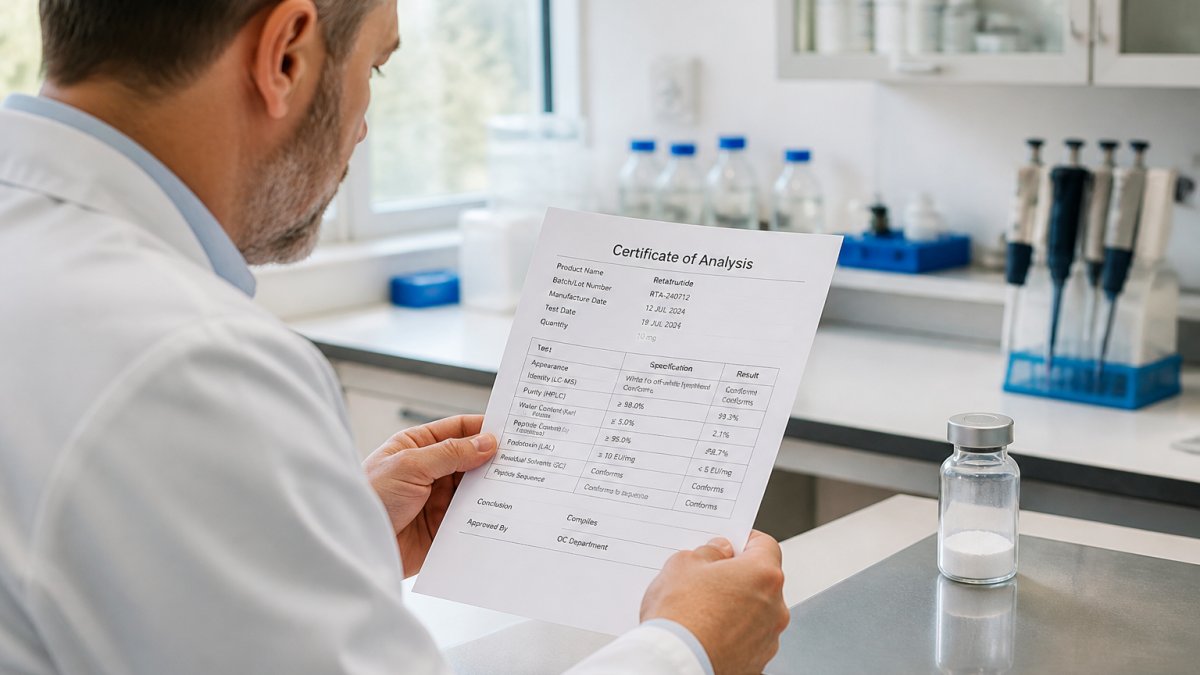
A genuine certificate should confirm three things: the compound identity matches the label, the purity percentage comes from a validated method such as HPLC, and the mass balance confirms the stated quantity. Independent verification means a laboratory with no commercial stake in the result performs that testing.
What most buyers miss is that a certificate is batch-specific, not product-specific. A supplier who issues one generic document for an entire product line is not providing traceability. Each batch needs its own analysis, tied to its own reference number.
The MHRA guidance on laboratory testing standards sets out the expectations for analytical rigour that reputable suppliers follow.
Retatrutide Availability: UK Stock and Delivery Timelines
Retatrutide availability depends on whether a supplier holds domestic stock or sources to order. UK-held inventory shortens delivery to days rather than weeks and avoids customs friction entirely.
Domestic stockholding is not free. It requires correct cold storage, batch segregation, and inventory tracking, all of which feed into retatrutide price. That overhead is the trade-off for reliability.
Researchers should ask two questions before ordering: is the compound in stock now, and what is the dispatch-to-delivery window? A supplier who cannot answer both clearly is a supply risk.
Ordering from overseas sellers to save on unit cost often backfires. Customs holds, temperature excursions in transit, and no recourse on damaged vials can wipe out any saving and delay a study.
Retatrutide vs Cagrilintide: Price and Specification Compared
Retatrutide vs Cagrilintide is a comparison researchers make constantly, because both are studied in metabolic research but differ in mechanism and specification. Retatrutide acts on three receptor pathways; Cagrilintide is a long-acting amylin analogue. That mechanistic difference shapes both synthesis cost and research application.
VOREVIA stocks Cagrilintide 10mg alongside Retatrutide 20mg, so researchers can compare specifications and batch documentation directly rather than across suppliers.
| Feature | Retatrutide | Cagrilintide |
|---|---|---|
| Receptor profile | Triple agonist | Amylin analogue |
| Common vial size | 20mg | 10mg |
| Primary research focus | Metabolic pathway studies | Amylin signalling research |
| Documentation | Batch-specific CoA | Batch-specific CoA |
Neither compound is inherently better. The choice depends entirely on the research question, and cost per mg should be assessed separately for each.
Evaluating Quality and Value Before You Buy
Value in research peptides comes from verified quality, not from the lowest number on a page. A researcher who buys on price alone often pays twice: once for the vial, and again in wasted assay time.
A practical pre-purchase checklist:
- Request the batch-specific Certificate of Analysis
- Confirm the purity method used (HPLC, not a vague claim)
- Verify the supplier holds domestic stock
- Calculate cost per mg at stated purity
- Check the dispatch and delivery window in writing
- Confirm the payment and documentation process suits your workflow
At VOREVIA, every batch ships with independent analytical verification and batch-specific documentation, so researchers can trace exactly what they received. The UK research governance framework underlines why traceability matters for reproducible work.
Research teams that need batch-traceable documentation and domestic stock without waiting weeks for overseas dispatch.
Conclusion
Comparing retatrutide price across suppliers is only useful when unit rate, purity, and documentation are weighed together. The cheapest vial is rarely the best value once testing and traceability are accounted for.
VOREVIA supplies research-grade Retatrutide 20mg, Cagrilintide 10mg, and GLOW 70mg with independent analytical verification, batch-specific Certificates of Analysis, secure bank-based payment, and dependable UK fulfilment. Every product is sold strictly for laboratory research.
SHOP RESEARCH COLLECTION →
Frequently Asked Questions
How much does retatrutide cost?
Retatrutide price varies by supplier, vial size and the level of documentation provided. Factors include synthesis origin, independent analytical verification, batch traceability and UK-based stock holding. Rather than quoting a single figure, compare cost per milligram across vial sizes and check whether the price includes a batch-specific certificate of analysis. Current pricing for VOREVIA’s Retatrutide 20mg is listed on the product page.
Why do retatrutide prices vary between suppliers?
Variation comes down to synthesis origin, purity levels, testing methods and whether documentation is batch-specific or generic. Suppliers holding UK stock and commissioning independent analysis carry higher costs than those drop-shipping from overseas. A lower retatrutide price per mg often reflects reduced testing frequency or shared certificates rather than genuine savings. Ask what analytical method was used and whether the certificate matches your specific batch number.
What should researchers check when comparing retatrutide prices?
Start with cost per milligram, not vial price. Then verify: does the supplier provide a batch-specific certificate of analysis from an independent laboratory? Is purity stated with the analytical method (typically HPLC)? Is the synthesis origin disclosed? Does the supplier hold UK stock for faster delivery? Compare retatrutide vs cagrilintide pricing only after confirming both meet your specification requirements. Documentation quality separates suppliers more reliably than headline pricing.
How can I verify the purity of research-grade retatrutide?
Request the batch-specific certificate of analysis and check that it names an independent testing laboratory, states the analytical method (HPLC is standard), and reports purity as a percentage with the chromatogram attached. Verify the batch number on the certificate matches the vial label. Reputable suppliers provide this documentation before purchase. If a supplier only offers a generic certificate covering multiple batches, that limits your ability to verify the specific material you receive.