
Table of Contents
- Why Lyophilised Peptide Stability Decides Whether Your Data Holds Up
- How Lyophilisation Protects Peptide Integrity
- Peptide Storage and Handling Best Practices in the Laboratory
- The Importance of Certificate of Analysis for Peptides
- Reading Stability Data: HPLC, Mass Spectrometry and Moisture Content
- How Lyophilised Peptide Stability Affects Reproducibility Across Batches
- Frequently Asked Questions
Last Updated: September 17, 2026
Why Lyophilised Peptide Stability Decides Whether Your Data Holds Up
The importance of lyophilised peptide stability in research comes down to one uncomfortable fact: a peptide that has degraded in storage is no longer the material your method was written around. This guide from VOREVIA explains why that matters and how to control it.
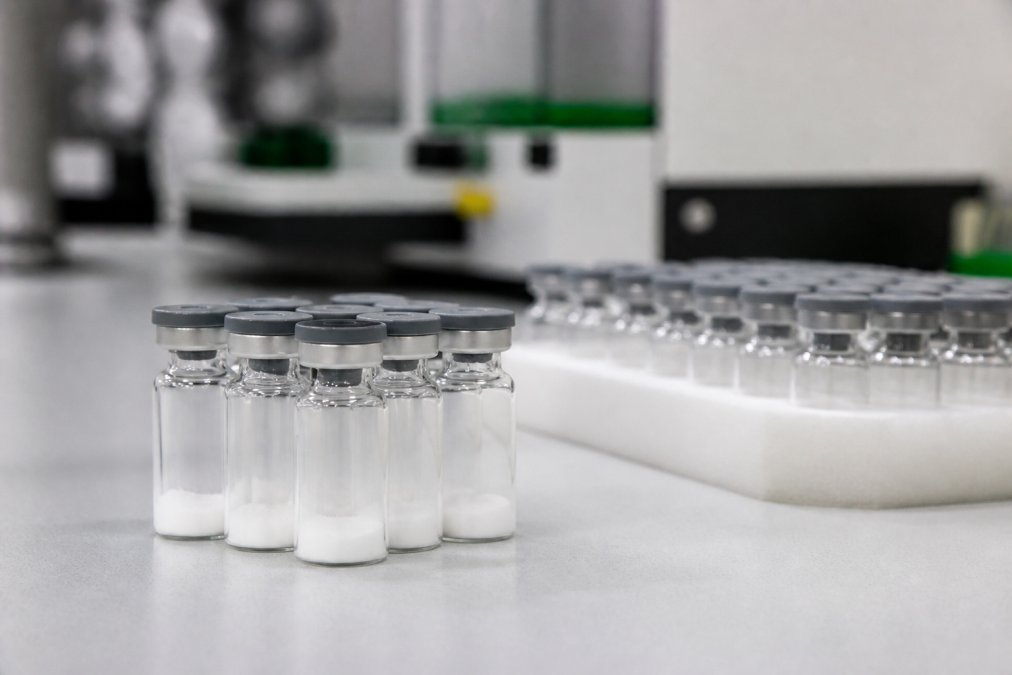
Lyophilisation removes water from a peptide solution under vacuum, leaving a dry powder that resists hydrolysis far better than its liquid equivalent. That protection is conditional, not permanent. Get the storage conditions wrong and the powder picks up moisture, oxidises, or aggregates. The assay still runs. The numbers still print. They just describe a different molecule from the one on the label.
Below, we break down how the drying process works, what good storage looks like in practice, and how to read the analytical documentation that tells you whether a batch is what it claims to be.
Most researchers treat stability as a supplier problem. It is not. It is a variable sitting inside your protocol, and it is one you can measure, document and control.
How Lyophilisation Protects Peptide Integrity
Lyophilisation protects peptides by removing the water that drives most degradation pathways. Hydrolytic cleavage, oxidation and microbial growth all need moisture or an aqueous environment to proceed. Remove both, and the reaction rates fall away.
The process runs in three stages:
- Freezing locks the peptide solution into a solid matrix
- Primary drying sublimates ice under reduced pressure, removing the bulk of the water
- Secondary drying desorbs bound water still clinging to the peptide structure
What most guides miss is that the formulation matters as much as the drying cycle. Bulking agents and lyoprotectants hold the peptide’s secondary structure in place while water leaves. Skip them, and the powder can come out as an amorphous, hygroscopic cake that reabsorbs moisture the moment the vial is opened.
That is why two suppliers can ship the same sequence and deliver very different materials. The sequence is identical. The drying process and excipient profile are not. Guidance from the European Medicines Agency on pharmaceutical quality documentation sets out how such quality attributes are expected to be documented, and the same logic applies to research-grade material.
Lyophilisation slows degradation. It does not stop it. The powder is a pause button, not a full stop.
Peptide Storage and Handling Best Practices in the Laboratory
Peptide storage and handling best practices come down to three things: keep it cold, keep it dry, and keep it sealed. Every handling error compounds the last one.
Temperature Control and Cold-Chain Discipline
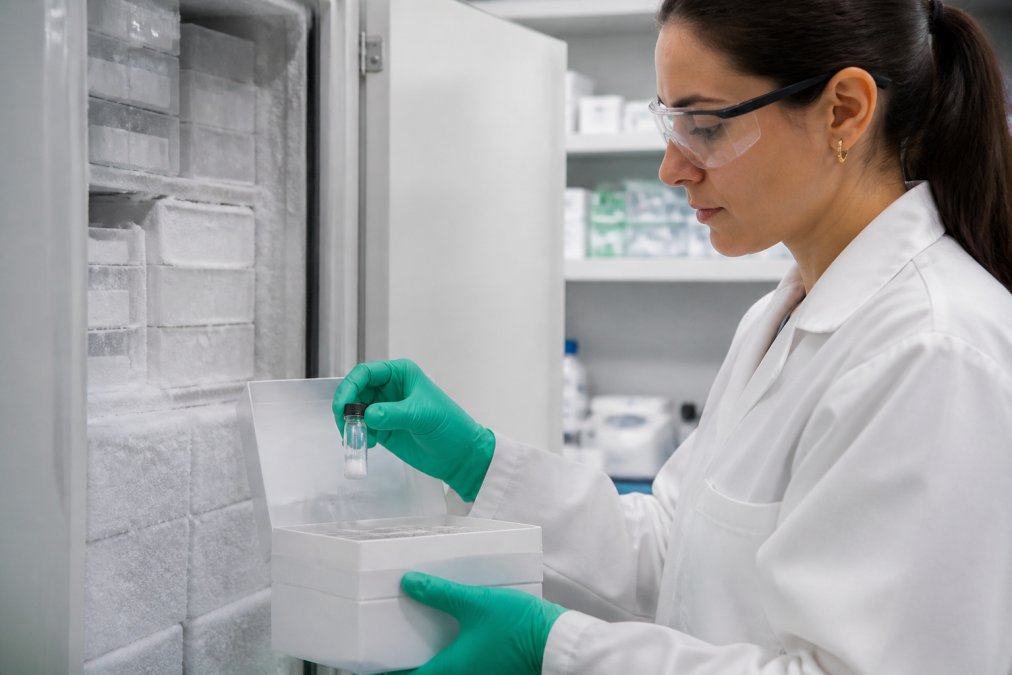
Store lyophilised powder at -20°C for standard work, and -80°C where the sequence is known to be labile. Frost-free freezers are a poor choice here: they cycle through thaw periods to prevent ice build-up, and that cycling exposes your vials to repeated small temperature swings.
A common mistake is trusting the freezer dial. A calibrated, independent thermometer inside the unit tells you what the samples actually experience. Log it.
Moisture, Light and Repeated Freeze-Thaw Cycles
Moisture is the primary enemy. Let vials reach room temperature before opening them. Open a cold vial and condensation forms on the powder immediately.
Light exposure drives oxidation of susceptible residues, so amber vials or light-protected boxes are worth the small extra cost. Repeated freeze-thaw cycles are the third problem: each cycle moves moisture around the matrix and stresses the structure. Aliquot before you freeze, not after.
Opening a vial straight from the freezer is the single most common handling error. Condensation introduces water directly onto the powder, and that water starts the hydrolysis you paid to prevent.
The Importance of Certificate of Analysis for Peptides
The importance of certificate of analysis for peptides lies in traceability. A COA is the document that connects a specific batch number to specific analytical results, and without it you have no way to know what you are working with.
What a Batch-Specific COA Should Tell You
A useful COA is batch-specific, not generic. It should identify the peptide, the batch or lot number, the sequence, the molecular weight, the purity figure with the method used to obtain it, and the test date. If the document could apply to any batch, it tells you nothing about yours.
Check that the batch number on the certificate matches the batch number on the vial. That single cross-check catches more problems than any other step.
Ask whether the testing was performed independently of the manufacturer. In-house testing is not worthless, but it is not independent verification. The distinction matters when your results need to withstand scrutiny.
Reading Stability Data: HPLC, Mass Spectrometry and Moisture Content
Stability data means little without the method behind it. Three techniques carry most of the weight in peptide analysis.
High-performance liquid chromatography (HPLC) separates the components of a sample and reports purity as a percentage of the total peak area. It tells you how much of the material is your target peptide and how much is related impurities.
Mass spectrometry (MS) confirms identity. It measures the mass of the molecule and confirms whether it matches the expected sequence. HPLC can report high purity on the wrong compound; MS catches that.
Moisture content, usually by Karl Fischer titration, tells you how much residual water remains in the powder. This is the figure most often missing from supplier documentation and the one most predictive of shelf behaviour.
| Analytical Method | What It Confirms | What It Misses |
|---|---|---|
| HPLC | Purity percentage, impurity profile | Whether the main peak is the right peptide |
| Mass spectrometry | Molecular identity, sequence match | Purity level |
| Karl Fischer titration | Residual moisture content | Identity and purity |
| Peptide content assay | Actual peptide mass vs total mass | Degradation products |
Read them together. A purity figure alone is a partial picture, and the United States Pharmacopeia general chapters on analytical procedures remain a widely referenced baseline for how such methods are validated.
How Lyophilised Peptide Stability Affects Reproducibility Across Batches
Reproducibility collapses when stability varies between batches. If batch A was stored correctly and batch B sat on a warm loading dock for a week, the two will behave differently in the same assay, and your results will drift for reasons that have nothing to do with your hypothesis.
This is where batch traceability earns its keep. When each batch arrives with its own documentation, you can compare analytical results across shipments and spot the outlier before it contaminates a dataset. VOREVIA supplies research materials with batch-specific documentation and independent analytical verification, so the analytical record travels with the material rather than disappearing at the point of sale. That same discipline extends to the ancillary materials a study depends on, from a lyophilised reference compound such as Retatrutide 20mg through to BAC Water 10ml for reconstitution in the laboratory, each supplied with the documentation to match.
A practical habit: record the batch number alongside every experimental result. When something does not reproduce, you have a variable to check rather than a mystery to chase. Documentation standards such as ISO 9001 quality management guidance describe the general principle of traceable records, and it applies just as well at bench level.
Research groups running multi-batch, multi-month studies where a single undocumented variable can invalidate a dataset.
Peptide stability is one of the few variables in a research protocol that you can control completely, and it is routinely neglected. VOREVIA supplies lyophilised research peptides with batch-specific certificates of analysis, independent analytical verification and full batch traceability, covering compounds including Retatrutide, Cagrilintide, BPC-157, TB-500, GHK-Cu and CJC-1295 No DAC + Ipamorelin. All products are supplied strictly for laboratory research use. Browse the research collection and check the documentation for your next batch before you commit it to a study.
Frequently Asked Questions
Why is lyophilisation the preferred method for long-term peptide storage?
Removing water slows the hydrolysis and oxidation reactions that break peptide bonds, so the powder remains chemically stable for far longer than a solution. The low residual moisture of a well-produced lyophilised cake also limits microbial growth and reduces the mobility of reactive species. This is why lyophilised peptide stability underpins most long-term research storage strategies, provided the vial stays sealed, cold and dry until it is needed.
How does moisture content affect the stability of lyophilised peptides?
Even small amounts of residual water accelerate degradation. Moisture enables hydrolytic cleavage of the peptide backbone and can promote aggregation, particularly when a vial is warmed before opening and condensation forms on the cake. Good peptide storage and handling best practices include letting vials reach room temperature while still sealed, keeping desiccant in storage boxes, and never storing a partly used vial in a humid environment.
What are the signs of peptide degradation in research samples?
Visible clues include a collapsed or shrunken cake, discolouration, cloudiness after reconstitution, or insoluble particles. Less obvious signs are a shift in retention time on HPLC, extra peaks suggesting truncated fragments, or a mass spectrometry result that no longer matches the expected molecular weight. Any of these should prompt a review of storage conditions and a check of the batch documentation before the material is used further.
Why is batch-specific documentation essential for research reproducibility?
Reproducibility depends on knowing exactly what was in the vial. A batch-specific certificate of analysis ties identity, purity and quantity data to a single lot number, so results from one study can be traced back to a defined material. Without it, a failed replication could stem from a different batch rather than the experimental design, and there is no way to tell which. This is the importance of certificate of analysis for peptides in practice.