
Table of Contents
- What 98% Purity Actually Means for Research Peptides
- How Peptide Purity Is Measured: HPLC and Beyond
- Understanding Peptide Impurities and Degradation
- Reading Your Peptide Certificate of Analysis
- Mass Spectrometry for Peptide Identity Confirmation
- Is 98% Purity Sufficient for Your Research Application?
- Choosing a Peptide Supplier You Can Trust
- Frequently Asked Questions
Last Updated: 11 October 2026
What 98% Purity Actually Means for Research Peptides
Is 98% purity good for peptides? The short answer is yes, for most research applications, 98% purity is an excellent standard. But that number alone tells only part of the story. Understanding what 98% purity actually represents, and how it impacts your research outcomes, requires looking beyond a single percentage.
When a peptide supplier reports 98% purity, they’re stating that 98% of the sample consists of the intended peptide molecule, with the remaining 2% comprising impurities, degradation products, or other molecular species. This threshold sits comfortably in the middle-to-upper range of what research-grade peptides typically achieve. Most academic and industrial researchers working with compounds like Retatrutide 20mg, Cagrilintide 10mg, or GHK-Cu 50mg expect purity levels between 95% and 99%.
The critical distinction is understanding what those impurities actually are. A 98% pure peptide that contains trace amounts of unreacted starting materials behaves very differently from one where the 2% consists of peptide dimers or oxidised variants. At VOREVIA, we prioritise transparent batch-specific documentation so researchers can see exactly what they’re receiving, not just a purity number, but the analytical evidence behind it.
How Peptide Purity Is Measured: HPLC and Beyond
High-Performance Liquid Chromatography (HPLC) is the gold standard for determining peptide purity. This technique separates peptide molecules based on their chemical properties as they pass through a specialised column, allowing laboratories to quantify the proportion of the target peptide versus contaminants.
HPLC works by dissolving your peptide sample and passing it through a stationary phase under high pressure. Different molecules interact with this phase at different rates, creating distinct peaks on a chromatogram. The area under each peak corresponds to the amount of that specific compound present. A pure peptide produces one dominant peak; impurities appear as smaller peaks alongside it.
The purity percentage you receive reflects the proportion of the main peak relative to all peaks detected. A 98% reading means the target peptide accounts for 98% of the total peak area. However, HPLC has limitations, it cannot identify what those impurities actually are without additional testing. This is where complementary techniques become essential for rigorous research.
Always request the full chromatogram alongside your purity percentage. A single number provides no context for whether impurities are acceptable for your specific application.
Understanding Peptide Impurities and Degradation
Not all impurities are equal. Some are harmless by-products of synthesis; others can significantly affect your experimental results. Common peptide impurities include:
- Unreacted starting materials, fragments of the precursor compounds used during synthesis
- Truncated peptides, incomplete versions missing one or more amino acids
- Oxidised variants, peptides where methionine or cysteine residues have oxidised, altering their properties
- Peptide dimers, two peptide molecules bonded together
- Residual solvents, organic compounds used during purification that weren’t fully removed
Degradation occurs over time, especially if peptides are stored improperly. Temperature fluctuations, exposure to light, and humidity can break peptide bonds or promote oxidation. A freshly synthesised peptide at 98% purity may degrade to 94% after six months of poor storage, same product, different conditions.
This is why batch-specific documentation matters. A certificate of analysis should include the synthesis date and recommended storage conditions. VOREVIA provides detailed batch information so you can track storage stability across your research timeline.
Peptides stored at room temperature in humid conditions can lose 2-5% purity per month. Always store research peptides at -20°C or below, in sealed, desiccated containers.
Reading Your Peptide Certificate of Analysis
Your certificate of analysis (CoA) is the most important document you’ll receive alongside your peptide shipment. It provides the analytical evidence for every claim about your product’s quality and identity.
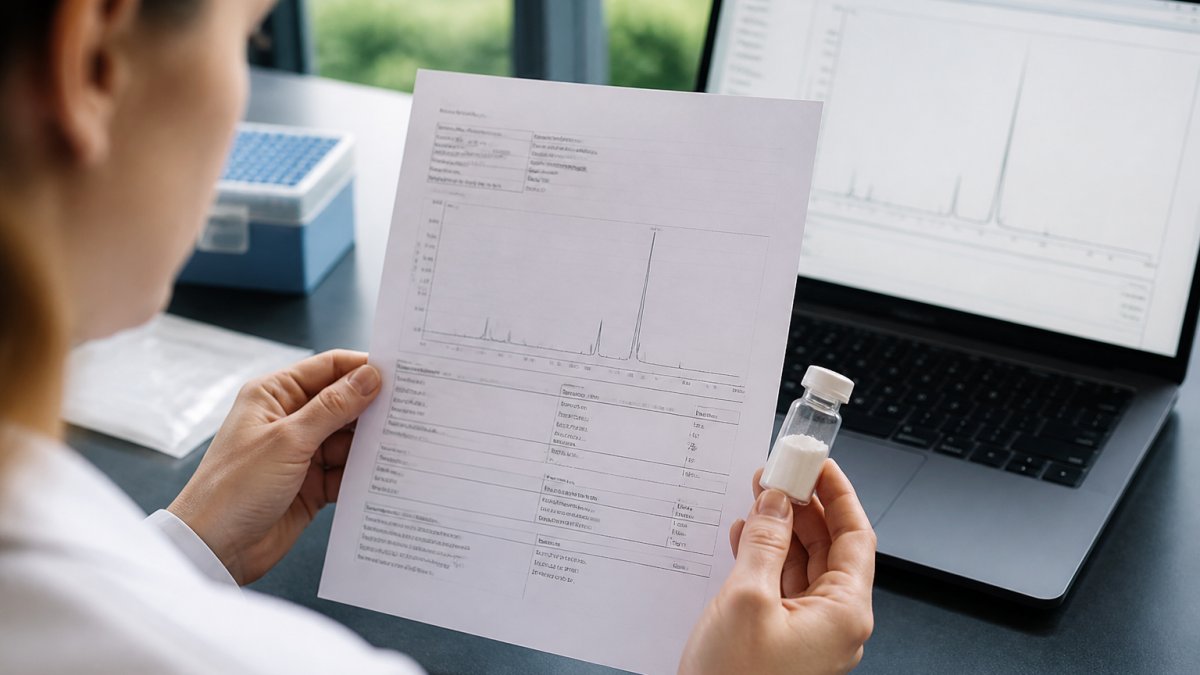
A proper CoA should include:
- Batch number, unique identifier linking this specific synthesis to its test results
- Purity percentage, typically measured by HPLC
- Molecular weight confirmation, verifying the peptide is actually what you ordered
- Test date, when the analysis was performed
- Testing method, which technique was used (HPLC, mass spectrometry, etc.)
- Storage recommendations, precise conditions for maintaining stability
- Expiry or re-test date, when the peptide should be re-analysed if stored long-term
Red flags include missing test dates, vague purity descriptions (“high purity” without a percentage), or certificates that lack the testing methodology. These gaps suggest the supplier either cannot verify their product or is unwilling to provide transparent documentation.
Independent analytical verification distinguishes trustworthy suppliers from those cutting corners. When a third-party laboratory tests your peptide, rather than the supplier testing their own product, you gain genuine confidence in the results.
Mass Spectrometry for Peptide Identity Confirmation
HPLC tells you how pure your peptide is, but mass spectrometry tells you what you actually have. This technique measures the molecular weight of your peptide with extraordinary precision, confirming that the compound matches your order.
Mass spectrometry ionises peptide molecules and measures their mass-to-charge ratio. Each peptide has a unique molecular weight based on its amino acid sequence. If you ordered Cagrilintide 10mg (molecular weight approximately 3,948 Da) and the mass spectrometry result shows 3,948 ± 5 Da, you have confirmation that the right peptide is in your vial.
This matters because two peptides can have similar HPLC retention times yet completely different biological properties. Mass spectrometry eliminates ambiguity. It’s the definitive proof of identity.
Responsible suppliers combine HPLC (for purity) with mass spectrometry (for identity) on every batch. This dual approach gives researchers the confidence that they’re working with exactly what they ordered, at the stated purity level.
Is 98% Purity Sufficient for Your Research Application?
Whether 98% purity meets your needs depends entirely on your research design. For most applications, cell culture studies, in vitro testing, preliminary screening, 98% purity is more than adequate. The impurities present at this level rarely interfere with results.
However, certain applications demand higher standards:
- Pharmacokinetic studies, tracking how a peptide moves through biological systems requires >99% purity to isolate the target compound’s behaviour
- Structural analysis, X-ray crystallography or NMR spectroscopy can be compromised by even small amounts of contaminants
- Regulatory submissions, pharmaceutical development or clinical trial materials often require ≥99.5% purity
- Potency assays, bioassays measuring peptide activity are sensitive to impurities that compete for the same receptors
For research-grade work with compounds like GLOW 70mg, BPC-157 10mg, or TB-500 10mg, 98% purity provides an excellent balance between cost and reliability. Most academic researchers find this level sufficient for strong, reproducible results.
Start with 98% purity for exploratory work. If your results show unexplained variability, request higher purity material (99%+) to rule out impurities as a confounding factor.
Choosing a Peptide Supplier You Can Trust
Purity percentages mean nothing without transparent verification. A supplier claiming 98% purity backed only by their own internal testing offers less assurance than one providing independent analytical data.
Key criteria for evaluating suppliers:
| Criterion | What to Look For | Why It Matters |
|---|---|---|
| Independent testing | Third-party lab results, not just supplier data | Eliminates conflict of interest |
| Batch-specific documentation | Unique CoA for each shipment | Proves traceability and consistency |
| Testing methodology | HPLC + mass spectrometry detailed | Confirms both purity and identity |
| Storage guidance | Precise temperature and humidity specs | Protects your investment long-term |
| Delivery timeframe | UK stock with fast shipping | Minimises time in transit, reduces degradation |
VOREVIA maintains UK-based stock of research peptides including Retatrutide, Cagrilintide, and GLOW, with independent analytical verification on every batch. This approach ensures you receive exactly what you’ve ordered, with transparent documentation proving it.
When you’re purchasing research peptides, 98% purity represents a solid standard for most applications. But that number only matters if it’s backed by transparent, independent verification. Researchers deserve to know exactly what they’re working with, not just a percentage, but the complete analytical picture. VOREVIA provides batch-specific certificates of analysis with independent testing, UK stock, and secure checkout so you can focus on your research with genuine confidence in your materials. SHOP RESEARCH COLLECTION →
Frequently Asked Questions
What does 98% peptide purity actually mean?
98% purity means that 98% of the sample’s mass consists of the target peptide, with the remaining 2% comprising impurities, water, salts, or degradation products. This measurement comes from analytical testing, typically HPLC, which separates compounds and quantifies each component. The figure represents the proportion by weight, not the number of molecules. For research applications, this level of purity is generally considered high-quality and suitable for most analytical and biological studies.
How is peptide purity measured in the laboratory?
Peptide purity is primarily measured using high-performance liquid chromatography (HPLC), which separates the peptide from impurities and quantifies each component as a percentage of the total sample. Mass spectrometry is often used alongside HPLC to confirm the identity and molecular weight of the peptide. Some suppliers also employ additional methods such as thin-layer chromatography or capillary electrophoresis. Independent analytical verification ensures the results are unbiased and traceable, which is essential for research reproducibility.
Can a peptide with 98% purity still contain harmful impurities?
Yes. A 98% purity figure tells you the proportion of the target peptide but not the nature of the 2% impurities. Those impurities could include residual solvents, salts, water, or degradation products. Some impurities are inert and pose no risk; others may interfere with your research or have biological effects. This is why reading the full certificate of analysis is critical, it should detail what the impurities are, not just the overall purity percentage. Reputable suppliers provide batch-specific documentation identifying each contaminant.
Is 98% purity better than 95% for research applications?
For most research applications, 98% purity is preferable to 95%, as it reduces variability and potential interference from impurities. However, the difference matters most in sensitive assays such as cell-based studies, receptor binding experiments, or analytical calibration. For some preliminary or exploratory work, 95% purity may be acceptable if cost is a constraint. The best choice depends on your specific experimental design, detection method, and regulatory requirements. Your certificate of analysis should guide this decision by showing exactly what impurities are present at each purity level.