
Last Updated: 29 October 2026
Quick Summary
Cagrilintide research focuses on a long-acting amylin analogue that binds amylin and calcitonin receptors in the hindbrain to influence satiety signalling and gastric emptying. Laboratories studying appetite and body weight track cumulative food intake, meal size and gastric emptying alongside metabolic endpoints. Sound cagrilintide research also depends on gentle reconstitution, single-use aliquots and batch-specific analytical documentation.
- Equilibrate the sealed vial to room temperature for 20-30 minutes before opening to limit moisture-driven aggregation.
- Add solvent down the vial wall and swirl gently; never vortex, as shear forces drive aggregation in lipidated peptides.
- A 10 mg vial reconstituted with 1.0 ml gives a nominal 10 mg/ml stock; 2.0 ml gives 5 mg/ml.
- Store lyophilised cagrilintide frozen, typically at −20 °C, and follow the batch specification where stated.
- Check that a certificate of analysis shows identity, purity, quantity and which laboratory performed the testing.
Table of Contents
- Cagrilintide Mechanism of Action in Metabolic Research
- Investigating the Benefits of Cagrilintide in Appetite and Satiety Studies
- Cagrilintide and Semaglutide Research: A Comparative Look at Incretin and Amylin Pathways
- Reconstitution Protocols for Cagrilintide Research
- Cagrilintide Storage and Handling for Laboratory Stability
- Assessing Cagrilintide Certificate of Analysis and Purity
- Sourcing Research-Grade Cagrilintide for Your Laboratory
- Frequently Asked Questions
Cagrilintide Mechanism of Action in Metabolic Research
Cagrilintide is a long-acting amylin analogue studied for its action at amylin and calcitonin receptors, where it influences satiety signalling and gastric emptying in metabolic research models.
The molecule is engineered for a longer half-life than native amylin. Lipidation slows clearance, which is why studies describe it as long-acting rather than fast-acting.
Receptor activation is the core event. Cagrilintide binds amylin receptors in the hindbrain, and that binding shapes how the body registers fullness. For a deeper walkthrough of the amylin pathway and how to separate published findings from product claims, see the educational overview of the amylin analogue model.
Three practical points for the bench:
- Amylin receptors are concentrated in the area postrema and nucleus tractus solitarius
- Satiety signalling is dose-dependent, so dose-response design matters
- Gastric emptying effects appear in the literature alongside appetite endpoints
Investigating the Benefits of Cagrilintide in Appetite and Satiety Studies
Researchers study cagrilintide for its long-acting profile in appetite and satiety models, which makes it relevant to studies measuring food intake over extended periods.
A common mistake is treating satiety as a single endpoint. In practice, researchers track several markers together:
- Cumulative food intake across fixed intervals
- Meal frequency and meal size separately
- Gastric emptying rate
- Body weight change over the study window
Pair appetite endpoints with metabolic pathways data where possible. Hormonal regulation is rarely a single-variable story.
Cagrilintide and Semaglutide Research: A Comparative Look at Incretin and Amylin Pathways
Cagrilintide and semaglutide work through different receptor families, which is exactly why researchers study them side by side. Semaglutide is an incretin agonist acting on GLP-1 receptors. Cagrilintide is an amylin analogue acting on amylin and calcitonin receptors.
| Feature | Cagrilintide | Semaglutide |
|---|---|---|
| Receptor family | Amylin / calcitonin | GLP-1 (incretin) |
| Primary pathway | Satiety signalling, gastric emptying | Incretin-mediated appetite control |
| Duration profile | Long-acting | Long-acting |
| Common research focus | Appetite and body weight | Glycaemic and weight endpoints |
The two pathways are complementary rather than competing. Studies that combine amylin and incretin mechanisms look at whether appetite suppression from two directions produces additive effects.
For laboratories comparing compounds, keep the analytical standards identical across both arms. Differences in purity or reconstitution can masquerade as pharmacological differences. That is a real trap, and it wastes months.
Reconstitution Protocols for Cagrilintide Research
Reconstitution is where many cagrilintide research projects quietly go wrong. The compound is supplied as a lyophilised powder, and how it is brought into solution can affect aggregation, recovery and the reproducibility of downstream assays.
Before you open the vial
Equilibrate the sealed vial to room temperature for 20-30 minutes before opening. Opening a cold vial draws moisture onto the lyophilised cake, and that surface moisture is one of the most common seeds for aggregation. Keep the desiccant sachet in place until the moment of use, and work on a clean, lint-free surface with gloves and eye protection.
Choosing the solvent
Cagrilintide is a lipidated amylin analogue, and the lipid chain changes how the molecule behaves at an air-water interface. For in-vitro work, the solvent choice should be dictated by the assay buffer rather than by habit:
- Sterile water for injection is the default for simple dilution series where the assay buffer will dominate the final composition.
- Phosphate-buffered saline at neutral pH is preferred where the downstream assay is sensitive to ionic strength or pH drift.
- A dilute acetic acid solution (typically around 0.1% v/v) is useful when recovery from the lyophilised cake is poor in neutral water; the slightly acidic environment helps resolubilise lipidated material.
Whichever solvent is chosen, record it. A reconstitution record that says ‘buffer’ is not a record, it is a guess.
Step-by-step reconstitution
- Equilibrate the sealed vial to room temperature.
- Prepare the solvent and bring it to the same temperature as the vial; thermal shock encourages precipitation.
- Calculate the target concentration before adding anything. For a 10 mg vial, adding 1.0 ml of solvent gives a nominal 10 mg/ml stock; adding 2.0 ml gives 5 mg/ml. Work out the working concentration you need first, then back-calculate the volume.
- Add the solvent down the vial wall, not directly onto the powder. Direct jetting onto the cake creates local high-concentration zones and foam.
- Swirl gently in a circular motion. Never vortex. Shear forces at the air-water interface are the single biggest cause of aggregation in lipidated peptides.
- Let it stand at room temperature until fully dissolved. Most vials clear within a few minutes; if the solution is still hazy after 15 minutes, do not assume it will clear with more agitation.
- Inspect against a dark background with a light source behind the vial. A clear, colourless to pale solution is expected. Particulates, cloudiness or a visible film on the glass are warning signs.
- Record the exact volume, solvent composition, temperature and time. This is the record that makes the assay reproducible by the next operator.
Do not filter a reconstituted solution to ‘clean it up’ unless the assay protocol explicitly allows it. Filtration can remove aggregated material along with a meaningful fraction of the active peptide, and it masks the handling problem rather than fixing it.
Concentration and aliquot strategy
Prepare a stock that is concentrated enough to avoid excessive dilution into the assay, but dilute enough that pipetting error stays small. A common pattern is a 1-5 mg/ml stock, aliquoted into single-use volumes and frozen. Repeated freeze-thaw of the same vial is one of the quietest sources of variability in peptide work; single-use aliquots remove that variable entirely.
Troubleshooting a failed reconstitution
| Observation | Likely cause | Practical response |
|---|---|---|
| Cloudy or milky solution | Aggregation, often from vortexing or cold solvent | Do not use for assay; discard and reconstitute a fresh aliquot with gentler handling |
| Visible particles or film | Incomplete dissolution or contamination | Inspect the vial before opening; discard if contamination is suspected |
| Solution clears then turns hazy on standing | Onset of aggregation at the air-water interface | Minimise headspace, keep capped, and use within the working window |
| Poor recovery from the cake | Solvent mismatch | Try a dilute acetic acid solvent and compare recovery |
For standardised protocol detail that keeps in-vitro work reproducible across operators, the peptide reconstitution guide for in vitro studies sets out the full method.
Cagrilintide Storage and Handling for Laboratory Stability
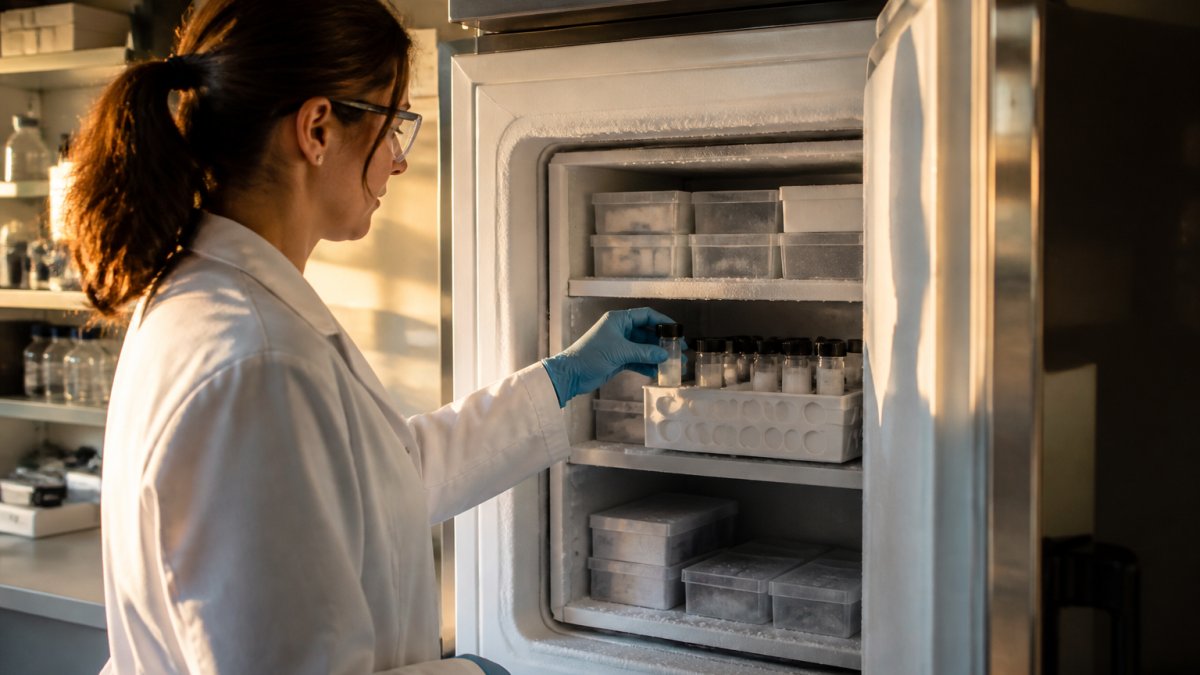
Follow the specification supplied with each batch for storage of lyophilised cagrilintide. Storage temperature requirements differ between peptides, which is why product-specific guidance beats blanket advice.
Lyophilised storage
- Temperature: keep the sealed vial frozen, typically at −20 °C for routine storage, and follow the batch specification where a colder set point is stated.
- Humidity: the lyophilised cake is hygroscopic. Keep the desiccant in place, reseal promptly after use, and avoid opening vials in humid rooms.
- Light: store in the dark or in the amber packaging supplied. Lipidated peptides are not immune to photodegradation.
- Headspace: minimise it. Repeated opening exchanges the inert headspace for moist lab air.
Reconstituted storage
Reconstituted material is far less stable than the lyophilised powder. Aliquot immediately after reconstitution into single-use volumes, freeze those aliquots, and thaw only the aliquot needed for the day’s work. Avoid refreezing thawed material. Keep reconstituted solutions capped and minimise the time they spend at bench temperature; a solution left uncapped on the bench for an afternoon is a solution that has been exposed to air, light and dust for an afternoon.
Recognising degradation before it ruins an assay
Degradation in a lipidated peptide rarely announces itself. The signs to watch for are:
- Haze or cloudiness in a solution that was previously clear, the classic early sign of aggregation.
- A visible film or ring on the inside of the vial at the meniscus.
- Loss of activity in a dose-response curve that previously behaved as expected, with no other protocol change.
- A shift in retention time or peak shape on analytical HPLC compared with the batch certificate.
- Unexpected colour change in the powder or solution.
Keep a small ‘reference aliquot’ from each batch, stored under the recommended conditions and never used for assay. When a result looks wrong, run the reference aliquot alongside the suspect material. If the reference behaves normally, the problem is handling; if it does not, the problem is the batch.
Handling rules that hold up in practice
- Keep the desiccant in place until the vial is needed.
- Aliquot reconstituted material to avoid repeat freeze-thaw.
- Label every aliquot with batch, date and concentration.
- Log storage conditions for research documentation.
- Never return a vial to the freezer after it has been at room temperature for an extended session; the condensation risk outweighs the saving.
Why storage must be product-specific is covered in the guide to lyophilised peptide stability.
Assessing Cagrilintide Certificate of Analysis and Purity
A cagrilintide certificate of analysis is most useful when it shows identity, purity and quantity results from stated methods, rather than a purity figure alone.
Check these before accepting any batch:
- Identity: molecular weight and amino acid sequence confirmation
- Purity: HPLC verified results with the method stated
- Quantity: measured content versus label claim
- Testing provenance: which laboratory performed the analysis
Purity analysis without method detail is hard to interpret. A reversed-phase HPLC trace with retention time and peak integration tells a researcher far more than a single percentage.
What most reviews miss is that batch traceability matters as much as the number. A purity figure you cannot tie to a specific batch and test date is not documentation, it is marketing. The guide to cagrilintide analytical documentation breaks down what a complete record should contain.
Sourcing Research-Grade Cagrilintide for Your Laboratory
Sourcing comes down to documentation and consistency. A supplier that provides batch-specific COAs, independent analytical verification and clear product information removes most of the risk from a purchase.
VOREVIA supplies Cagrilintide 10mg with batch-specific documentation and independent analytical verification.
What to ask any provider before ordering:
- Can you supply a batch-specific COA with method detail?
- Is testing performed independently of the supplier?
- How is the material stored and shipped?
- What documentation accompanies the shipment?
Frequently Asked Questions
What is cagrilintide being studied for?
Cagrilintide research primarily focuses on its potential role in metabolic regulation, particularly concerning appetite suppression and satiety signalling. As a long-acting amylin analogue, studies investigate its interactions with amylin and calcitonin receptors to understand how it may influence gastric emptying and body weight in preclinical models. Researchers are also exploring its effects on hormonal regulation pathways and its potential as an incretin agonist in combination with other compounds.
How should research-grade cagrilintide be stored and handled?
Follow the batch specification for storage of lyophilised cagrilintide, and handle reconstituted material according to your laboratory’s protocol. Always use sterile technique and follow your laboratory’s standard operating procedures for handling a laboratory chemical to ensure both material integrity and personal safety.
What information should a cagrilintide certificate of analysis include?
A comprehensive cagrilintide certificate of analysis (COA) should provide batch-specific data on identity and purity. This includes the amino acid sequence, molecular weight confirmation (often via mass spectrometry), and purity analysis results from HPLC verified methods. Look for documentation of the testing methodology and the date of analysis to ensure full traceability and to support your own research documentation.
What does current research say about cagrilintide and appetite?
Current cagrilintide research suggests it acts as a potent amylin analogue, influencing satiety signalling pathways. Its long-acting profile makes it a subject of interest for metabolic research, with many studies comparing its effects to other peptide hormones to understand its full pharmacological potential.
Reproducible metabolic research depends on material you can trust and documentation you can verify. VOREVIA supports that with independent analytical verification, batch-specific certificates of analysis and UK-based stock ready for dispatch. Get started with VOREVIA and build your next study on a traceable, verified supply.
