

Table of Contents
- Why Storing Research Peptides Correctly Matters for Reproducibility
- Lyophilised Peptide Storage Temperature: What the Evidence Supports
- Peptide Stability and Degradation Factors You Can Control
- Peptide Reconstitution Protocols: Preparing Solutions for Storage
- Storing Research Peptides in Solution: When and How
- Documentation, Batch Traceability and Inventory Management
- Common Storage Pitfalls and How to Avoid Them
- Conclusion: Building a Reliable Storage Workflow
- Frequently Asked Questions
Last Updated: 23 September 2026
Why Storing Research Peptides Correctly Matters for Reproducibility
Best practices for storing laboratory research peptides begin with a simple principle: an assay is only as trustworthy as the material that went into it. A vial that has degraded quietly in a warm drawer will not announce itself. It will simply produce data that cannot be repeated, and the failure will be attributed to the method rather than the sample.
This guide from VOREVIA sets out the storage, handling and documentation practices that protect reproducibility, from the freezer through to reconstitution and inventory records. VOREVIA supplies research peptides and laboratory materials with batch-specific documentation and independent analytical verification, so the storage workflow starts from a known baseline. What happens after delivery determines whether that baseline holds.
The stakes are practical rather than theoretical. A peptide that has absorbed moisture, cycled through repeated freeze-thaw events or sat too long in ambient light may still pass a casual visual inspection while no longer performing as the certificate of analysis describes. Below, we break down the storage conditions, degradation factors and documentation habits that keep results defensible.
Lyophilised Peptide Storage Temperature: What the Evidence Supports
Lyophilised peptide storage temperature is the single most consequential variable in any peptide workflow. The general consensus in peptide research is that lyophilised powder is most stable when held cold, dry and dark, with -20°C as the common working standard and -80°C reserved for longer horizons or less stable sequences.
The rationale is straightforward. Lyophilisation removes bulk water, which slows the hydrolysis and oxidation reactions that degrade peptide chains. Cold storage further reduces molecular mobility. Neither step stops degradation entirely, which is why the storage decision should match the intended holding period rather than defaulting to the coldest available option.
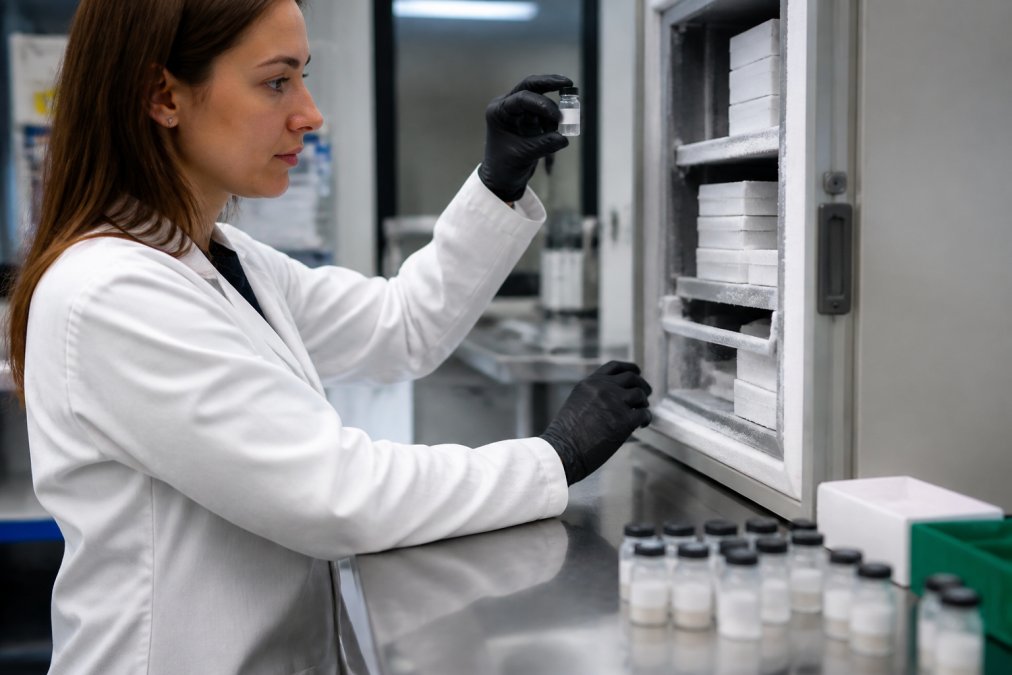
Long-Term Storage at -20°C Versus -80°C
For most lyophilised research peptides, -20°C is adequate for routine holding periods measured in months. A -80°C freezer becomes the better choice when a peptide is known to be less stable, when the holding period stretches beyond the typical working horizon, or when a laboratory wants a wider margin against temperature fluctuation.
The trade-off is not cost alone. Ultra-low freezers are more prone to frost accumulation and door-opening temperature excursions, and they consume more energy. A poorly maintained -80°C unit can expose samples to more thermal stress than a well-run -20°C freezer. The freezer that stays closed and holds a steady temperature usually outperforms the colder one that is opened constantly.
Keep a small working aliquot of each peptide in a separate, frequently accessed container. This keeps the main stock vial sealed and undisturbed, so the bulk of the material never experiences the temperature swings of routine bench work.
Short-Term Handling and Desiccated Transport
Short-term handling covers the period between removing a vial from the freezer and returning it. The goal is to minimise the time the powder spends at ambient temperature and to prevent condensation from forming on the cold vial surface.
Desiccated transport matters for the same reason. A sealed pouch with desiccant protects the powder from ambient humidity during shipping and short-term movement between sites. Once the pouch is opened, the desiccant’s protection ends, and the vial should be transferred to its storage location promptly.
Peptide Stability and Degradation Factors You Can Control
Peptide stability and degradation factors fall into two groups: the ones a laboratory can control and the ones it cannot. Sequence, intrinsic lability and the manufacturing process belong to the second group. Moisture, oxygen, light and thermal cycling belong to the first, and they are where most avoidable losses occur.
Moisture, Oxygen and Light Exposure
Moisture is the most common culprit. A lyophilised powder is hygroscopic to varying degrees depending on the sequence, and every exposure to humid air introduces water that accelerates hydrolysis. Brief opening of a vial in a humid room can be enough to compromise the top of the powder cake.
Oxygen drives oxidation of susceptible residues, particularly methionine and cysteine. Light exposure, especially ultraviolet, can trigger photodegradation. The practical response is to keep vials sealed, store them in the dark, and work quickly when a vial must be opened.
Freeze-Thaw Cycles and Repeated Warming
Freeze-thaw cycles are the quiet destroyer of peptide integrity. Each cycle subjects the material to ice crystal formation and re-dissolution, and the cumulative effect on a reconstituted solution is greater than on a dry powder. Repeated warming to room temperature before use has a similar cost.
A common mistake is thawing an entire stock solution for a single small experiment, then refreezing the remainder. The better approach is to prepare single-use aliquots at the point of reconstitution, so each portion is thawed once and used once.
Leaving a reconstituted solution on the bench for hours while an experiment runs is a frequent source of unexplained variability. Prepare only what the protocol requires and return the rest to storage immediately.
Peptide Reconstitution Protocols: Preparing Solutions for Storage
Peptide reconstitution protocols determine how long a solution remains usable and how much of the original material survives. The choice of diluent, the technique used to introduce it, and the way the resulting solution is divided all matter.
Bacteriostatic water is the common diluent for research solutions because the preservative limits microbial growth in multi-use vials.
Storing Research Peptides in Solution: When and How
Storing research peptides in solution is sometimes unavoidable, but it should be treated as the exception rather than the default. Solutions are less stable than lyophilised powder because water is present and degradation reactions proceed more readily.
| Storage Form | Typical Holding Condition | Best Suited To | Main Risk |
|---|---|---|---|
| Lyophilised powder | -20°C, desiccated, dark | Routine long-term holding | Moisture ingress on opening |
| Lyophilised powder | -80°C, desiccated, dark | Less stable sequences, long horizons | Frost and door-opening excursions |
| Reconstituted solution | 2-8°C, protected from light | Short-term working use | Hydrolysis and microbial growth |
| Frozen aliquot | -20°C or below, single-use | Preserving a prepared solution | Freeze-thaw damage if reused |
Documentation, Batch Traceability and Inventory Management
Documentation and batch traceability turn a storage routine into a reproducible system. Without records, a laboratory cannot say which batch produced which result, or whether a change in outcome followed a change in material.
Batch-specific documentation is what allows a result to be traced back to a specific material. When a laboratory can name the batch behind every dataset, troubleshooting becomes a matter of evidence rather than guesswork.
Common Storage Pitfalls and How to Avoid Them
Most storage failures trace back to a small number of habits. Recognising them in advance is cheaper than repeating an experiment.
- Opening vials in humid conditions. Work in a dry environment and reseal promptly. Condensation on a cold vial introduces water directly into the powder.
- Refreezing thawed solution. Divide into single-use aliquots at reconstitution so nothing is thawed twice.
- Storing in a frost-free freezer without protection. Frost-free cycles cause temperature fluctuation. Use a sealed container and monitor the actual internal temperature.
- Relying on visual inspection. A degraded peptide may look unchanged. Trust the storage record, not the appearance of the powder.
- Mixing batches in one container. This destroys traceability and makes any later problem impossible to attribute.
Laboratories that need consistent, batch-traceable material with independent analytical verification and clear documentation to support storage and reproducibility records.
Conclusion: Building a Reliable Storage Workflow
A reliable storage workflow is less about any single freezer setting and more about consistency across the whole chain: cold, dry, dark storage, single-use aliquots, prompt reconstitution and records that name the batch behind every result. Laboratories that get these habits right spend less time chasing unexplained variability.
Frequently Asked Questions
What is the optimal temperature for long-term peptide storage?
For lyophilised research peptides, -20°C is the standard long-term storage temperature, and many laboratories use -80°C for extended archival storage of particularly labile sequences. The key is consistency: avoid temperature fluctuations, keep vials desiccated, and allow sealed vials to equilibrate to room temperature before opening to prevent condensation. Always follow the storage guidance supplied with the specific batch, as optimal conditions can vary between compounds. Storing research peptides at a stable, documented temperature is one of the simplest ways to protect reproducibility.
Should research peptides be stored in solution or as a lyophilised powder?
Lyophilised powder is the preferred form for long-term storage because it is more stable and less prone to hydrolysis and microbial contamination. Once reconstituted, solutions are generally held at 2-8°C for short-term use, with aliquoting into single-use volumes to avoid repeated freeze-thaw cycles. If a solution must be frozen, aliquot first and store at -20°C or lower. For most research workflows, keeping the bulk of material as powder and reconstituting only what is needed for a defined period gives the best balance of stability and convenience.
How do I prevent peptide degradation during storage?
The main controllable factors in peptide stability and degradation are moisture, oxygen, light, heat and mechanical handling. Keep vials sealed with desiccant, store in the dark, maintain a stable sub-zero temperature, and minimise freeze-thaw cycles by aliquoting. Avoid repeatedly warming and cooling stock vials, and never store working solutions for longer than the protocol allows. Using batch-traceable materials with independent analytical documentation, such as those supplied by VOREVIA, also helps you distinguish a storage problem from a starting-material issue.
What documentation should be maintained for peptide inventory management?
A practical inventory record should include the compound name, batch or lot number, quantity, purity specification, date of receipt, storage location and temperature, and the certificate of analysis reference. Log any reconstitution events, including the diluent used, concentration, date and storage conditions of the resulting solution. This record supports reproducibility and makes it easier to trace any unexpected result back to a specific batch or handling step. Retaining batch-specific documentation from your supplier alongside your own logs gives a complete chain of custody.
Storage discipline is the least glamorous part of peptide research and one of the most common reasons results fail to reproduce. VOREVIA supports that discipline with batch-specific documentation, independent analytical verification and dependable fulfilment, so the material arriving at the bench is traceable from the start. Explore the research collection and build a storage workflow that holds up to scrutiny.
SHOP RESEARCH COLLECTION →