
Table of Contents
- Why Peptide Integrity Matters in Laboratory Transport
- Peptide Stability During Shipping: Temperature, Time and Handling
- Packaging and Cold-Chain Materials for Sensitive Research Peptides
- Analytical Verification of Research Peptides on Arrival
- Best Practices for Peptide Storage After Delivery
- Documentation and Batch Traceability Through the Supply Chain
- Common Mistakes That Compromise Peptide Integrity in Transit
- Conclusion
- Frequently Asked Questions
Last Updated: 15 September 2026
Why Peptide Integrity Matters in Laboratory Transport
Maintaining peptide integrity during laboratory transport is the practice of protecting a research peptide’s identity, purity and quantity from the moment it leaves storage to the moment it is received and verified. It matters because a peptide that degrades in transit invalidates the experiment it was purchased for, and no analytical result can recover material that arrived compromised. This guide from VOREVIA covers the temperature ranges, packaging choices and documentation that keep research materials fit for purpose. A vial is only as good as the chain that carried it, and that chain is usually invisible to the researcher who opens the box.
Most procurement decisions focus on the compound and the certificate. Fewer teams audit the journey.
The practical reality is that maintaining peptide integrity during laboratory transport depends on three variables working together: temperature, time and handling. Get any one of them wrong and the other two cannot compensate. A perfectly insulated box still fails if it sits on a loading dock for two days.
Transport is not a gap between storage and use. It is a storage condition in its own right, and it needs to be specified, documented and verified like any other.
Peptide Stability During Shipping: Temperature, Time and Handling
Peptide stability during shipping is governed by the interaction of thermal exposure, transit duration and physical handling, not by any single factor in isolation. Lyophilised peptides are generally more tolerant of ambient variation than reconstituted material, but tolerance is not immunity. Research from the European Directorate for the Quality of Medicines guidance on pharmaceutical cold chain underlines that excursion duration matters as much as excursion magnitude.
Temperature ranges differ by material state and formulation:
- Lyophilised powder: often held cool and dry, away from direct light
- Reconstituted solution: typically requires tighter, continuous cold conditions
- Buffered or salt-containing formulations: may behave differently from simple aqueous solutions
Freeze-thaw cycling is the quiet culprit. Repeated transitions between frozen and liquid states can encourage aggregation and adsorption to vial walls, and each cycle adds a small irreversible loss. A shipment that thaws twice en route is not equivalent to one that never thawed.
Time compounds everything. A short domestic journey in mild weather is a different risk profile from a multi-day international consignment, and the packaging should reflect which one is being planned.
Packaging and Cold-Chain Materials for Sensitive Research Peptides
Packaging for sensitive research peptides combines primary containment, thermal control and physical protection, and each layer has a distinct job. The primary container holds the material. The thermal layer slows heat transfer. The outer layer absorbs shock and keeps the assembly intact.
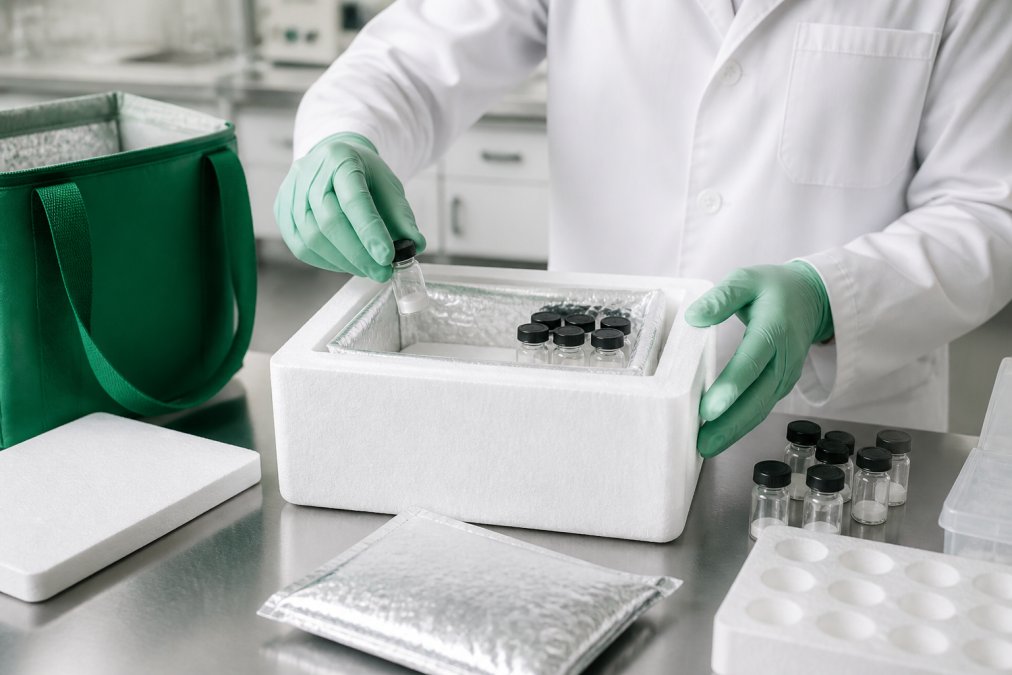
A common mistake is overfilling the coolant compartment. Too much coolant in direct contact with vials can drive the contents below their intended range, which is its own form of excursion. The goal is a stable band, not the coldest possible box.
Materials that tend to work well:
- Insulated rigid outer boxes rather than soft mailers
- Phase-change coolant packs for tighter temperature bands
- Secondary containment and absorbent material for liquid formats
- Tamper-evident seals that show whether the box was opened
For UK-based researchers ordering domestic stock, transit windows are typically short, which reduces thermal risk considerably. According to the MHRA’s guidance on the transport of medicines and investigational products, temperature control during distribution should be documented and justified, and that principle applies to research materials held to comparable standards.
Analytical Verification of Research Peptides on Arrival
Analytical verification of research peptides on arrival is the step that converts an assumption of quality into evidence. It begins with the batch-specific Certificate of Analysis and continues with whatever in-house checks the receiving laboratory is equipped to run.
What to check first:
- Batch number on the vial matches the Certificate of Analysis exactly
- Identity confirmation by mass spectrometry where available
- Purity assessment by HPLC, read against the stated method
- Appearance, fill volume and vial integrity
The thing nobody tells you about arrival checks is how often the batch number is the failure point. A supplier may hold excellent documentation for a batch that is not the batch in the box. That mismatch is a documentation failure, not necessarily a material failure, but it should stop the material entering a study until it is resolved.
Never accept a generic or non-batch-specific Certificate of Analysis as sufficient. Without a batch identifier tying the document to the vial, the certificate proves nothing about the material in front of you.
Where results look inconsistent with a previous lot, the sensible sequence is to re-run the check before concluding the material is at fault. Method drift, column age and calibration all produce variation that has nothing to do with the peptide.
Best Practices for Peptide Storage After Delivery
Best practices for peptide storage after delivery start with moving the material into its intended condition quickly, then recording what happened between dispatch and receipt. The faster that transition, the smaller the unaccounted-for window.
Practical steps on arrival:
- Inspect the outer packaging and note any damage before opening
- Confirm the coolant packs are still within their working range
- Record the arrival temperature if the shipment included a logger
- Transfer to the specified storage condition without delay
- File the Certificate of Analysis against the batch number
Storage conditions should follow the supplier’s stated guidance for that specific material rather than a general rule applied across the catalogue. Lyophilised and reconstituted formats frequently differ, and a condition that suits one may not suit the other. Where a reconstitution step is required for a lyophilised format, the diluent itself becomes part of the storage equation, and a suitable bacteriostatic water such as BAC Water 10ml is typically used for this purpose in the laboratory.
A common mistake is storing material in a frost-free freezer without understanding its defrost cycles. These units cycle temperature deliberately, which is exactly the pattern that stresses sensitive compounds. If a frost-free unit is the only option, secondary containment and a clear record of when the material was moved will at least make the exposure traceable.
Documentation and Batch Traceability Through the Supply Chain
Documentation and batch traceability through the supply chain are what allow a researcher to reconstruct a material’s history months after delivery. Traceability is the ability to follow a specific batch from its origin through every transfer, storage condition and dispatch, and to demonstrate that chain with records.
At minimum, a traceable consignment should carry:
| Record | Purpose | Who Holds It |
|---|---|---|
| Batch-specific Certificate of Analysis | Confirms identity, purity and quantity | Supplier and researcher |
| Dispatch and arrival dates | Establishes the transit window | Supplier and courier |
| Temperature logger data | Shows conditions during transit | Courier or supplier |
| Storage transfer log | Records movement between conditions | Receiving laboratory |
| Deviation notes | Captures excursions and how they were handled | Receiving laboratory |
VOREVIA supplies batch-specific documentation with its research catalogue, including Certificates of Analysis tied to the specific lot dispatched, so that the receiving laboratory can verify what it has rather than what was advertised. This sits alongside VOREVIA Quality Assurance, which underpins the documentation and handling standards applied across the catalogue. The UK government guidance on good distribution practice reinforces that records should be contemporaneous and retained, since a log reconstructed from memory is of limited value in an audit.
Common Mistakes That Compromise Peptide Integrity in Transit
The mistakes that compromise peptide integrity in transit are rarely dramatic. They are small omissions that compound.
The most frequent ones:
- Ambient dispatch of material that needs cold conditions. Convenience wins over specification, and the loss is invisible until assay.
- Repeated freeze-thaw cycles. Often caused by aliquoting decisions made after arrival rather than before dispatch.
- Coolant in direct contact with vials. Produces a freeze excursion in the name of keeping things cold.
- No temperature record. Without data, an excursion cannot be shown to have happened or to have been avoided.
- Batch mismatch between vial and certificate. A paperwork failure that undermines otherwise sound material.
- Delayed unpacking. Material sits in a warm room because nobody owned the receiving step.
What most guides miss is that the receiving laboratory controls at least half of these.
Aliquot before you freeze, not after. Deciding your working volumes while the material is still in its original condition avoids the thaw-and-refreeze cycle that quietly costs you material every time.
Conclusion
Frequently Asked Questions
What are the primary factors affecting peptide stability during shipping?
Temperature is the biggest factor, followed by time in transit, mechanical shock and light exposure. Repeated warming and cooling cycles accelerate degradation, so a shipment that stays cold but fluctuates is often worse than one held steadily at a controlled temperature. Humidity, vibration during road transport and delays at sorting depots all add risk. Choosing a supplier that packs to a defined cold-chain specification and ships to minimise transit time reduces these variables considerably.
How does temperature fluctuation impact peptide integrity?
Each freeze-thaw cycle can disrupt the peptide’s secondary structure and encourage aggregation, particularly for peptides stored in solution. Lyophilised material is more tolerant but still degrades faster when exposed to repeated warming. The practical takeaway is to avoid unnecessary transfers between freezers and to log temperature during transit where the study design requires it. If a shipment arrives warm, document the condition before use rather than assuming the material is unaffected.
How can researchers verify peptide quality upon arrival?
Start by checking the batch number on the vial against the accompanying Certificate of Analysis. Inspect the physical state of the lyophilised powder or solution for discolouration, clumping or unexpected particulates. Where the study requires it, arrange independent analytical verification of research peptides, such as HPLC for purity and mass spectrometry for identity, and record the results against the batch documentation. This creates a traceable record that supports reproducibility across the project.
What are the risks of improper peptide storage during transit?
Poor storage in transit can lead to hydrolysis, oxidation, deamidation and aggregation, all of which reduce the usable quantity of intact peptide and can skew experimental results. The damage is not always visible on inspection, which is why batch-specific documentation and, where appropriate, post-arrival analytical testing matter. Storing received material promptly at the temperature specified in the supplier’s documentation, and avoiding repeated freeze-thaw cycles, protects both the sample and the integrity of the research record.