

Last Updated: 24 October 2026
Quick Summary
Peptide testing education involves understanding HPLC analysis to verify purity, mass spectrometry to confirm molecular structure, and learning to read Certificates of Analysis from independent laboratories. These skills ensure your research peptides meet quality standards and your experimental results remain valid and reproducible.
- HPLC testing identifies peptide purity by measuring the percentage of your target compound versus impurities and degradation products.
- Mass spectrometry confirms exact molecular weight and structure, detecting oxidation or incomplete synthesis that HPLC alone might miss.
- A reliable Certificate of Analysis includes batch number, testing date, purity percentage with methodology, and results from an independent laboratory.
- Independent third-party testing removes supplier bias and provides objective verification of peptide quality and purity claims.
- Batch-to-batch consistency across multiple orders indicates genuine process control and reliable supplier quality assurance.
Table of Contents
- Why peptide testing education matters for research integrity
- Understanding peptide HPLC testing and what it reveals
- Peptide mass spectrometry: identifying molecular structure
- Reading a peptide certificate of analysis
- Selecting a third-party peptide testing laboratory
- Essential laboratory tools and products for peptide research
- Building confidence in your research peptide supply
- Frequently Asked Questions
Why peptide testing education matters for research integrity
Research peptides form the foundation of rigorous scientific investigation, but their quality directly determines the validity of your results. A contaminated or mislabelled batch can invalidate months of work, waste resources, and compromise your research credibility.
The challenge is that peptide testing education isn’t always straightforward. Suppliers vary dramatically in their transparency and testing rigour. Some offer only internal verification; others provide independent analytical confirmation. Understanding what those tests actually measure, how to read the documentation, and which third-party verification truly matters separates researchers who can trust their results from those who cannot.
Research Peptides and Laboratory Products has invested in independent analytical verification and batch-specific documentation precisely because this transparency gap exists. The ability to trace a peptide back to its source, verify its identity and purity, and understand the testing methodology behind those claims transforms how you approach your research.
Understanding peptide HPLC testing and what it reveals
High-Performance Liquid Chromatography (HPLC) is the workhorse of peptide analysis.
When you receive an HPLC report, you’re looking at a chromatogram, a visual representation of peaks, each representing a different molecular component. The largest peak should be your target peptide. Smaller peaks indicate impurities, byproducts, or degradation products.
HPLC testing reveals several critical details. First, it confirms the peptide’s identity by comparing its retention time (how long it takes to pass through the column) against known standards. Second, it quantifies purity, the percentage of your sample that is the actual peptide you ordered. Third, it identifies impurities, which matters because some contamination is harmless while other byproducts can actively interfere with your research.
The limitation of HPLC alone is that it doesn’t definitively prove molecular structure. HPLC and mass spectrometry complement one another when assessing peptide research materials, providing both separation and definitive structural confirmation. Two different molecules might have similar retention times.
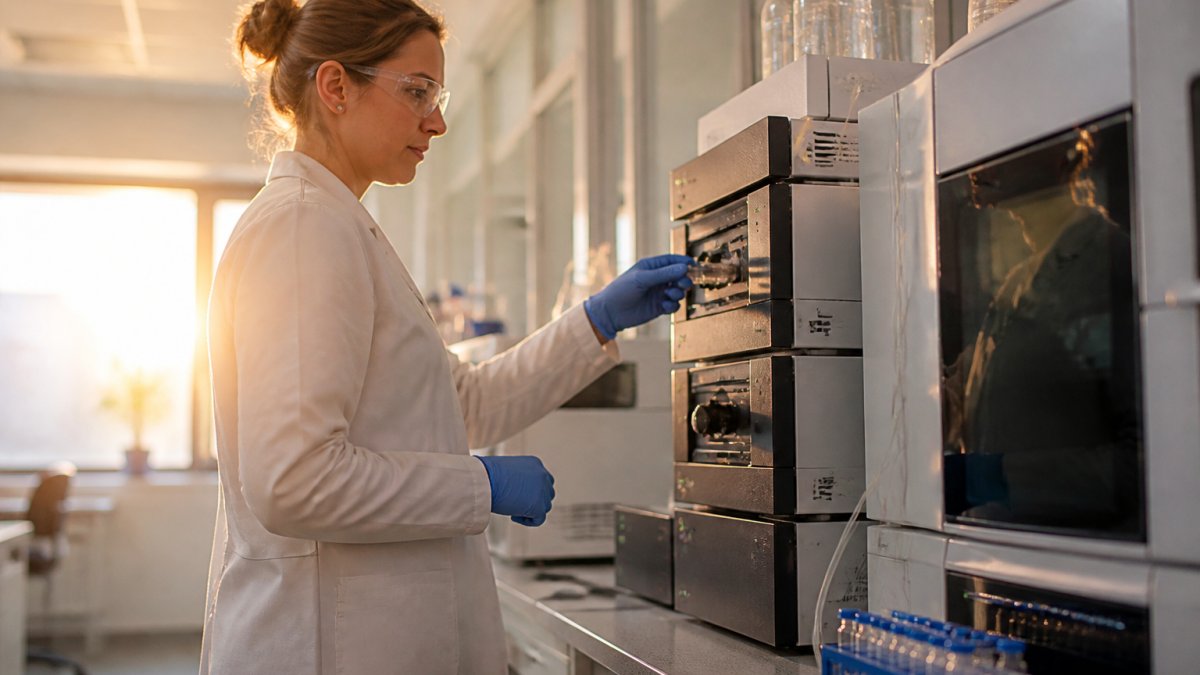
HPLC testing reveals several critical details about your peptide sample through different analytical measurements.
| What HPLC reveals | How it’s measured | What it tells you |
|---|---|---|
| Peptide identity | Retention time compared to known standards | Confirms the peptide you ordered |
| Purity percentage | Area under the curve analysis | Whether sample is 95% or higher pure |
| Impurities and byproducts | Smaller peaks on chromatogram | What contamination is present |
| Degradation products | Peak identification and quantification | Whether sample has degraded during storage |
Peptide mass spectrometry: identifying molecular structure
Mass spectrometry (MS) answers the question HPLC cannot fully resolve: what is the actual molecular weight and structure of your peptide? This technique ionises peptide molecules and measures their mass-to-charge ratio, creating a mass spectrum that acts as a molecular fingerprint.
When combined with HPLC, often called LC-MS, this pairing becomes powerful. HPLC separates the components; mass spectrometry identifies each one definitively. For peptides, this means confirming exact amino acid sequence and detecting any unexpected modifications or degradation.
A mass spectrum for a pure peptide shows a clear molecular ion peak at the expected mass. Multiple peaks or unexpected masses indicate structural problems, incomplete synthesis, oxidation, or contamination.
This is particularly important for research applications where peptide structure directly affects biological activity. A peptide that looks pure by HPLC but has undergone oxidation or incomplete synthesis will behave differently in your experiments. Mass spectrometry catches these issues that HPLC alone might miss.
Reading a peptide certificate of analysis
A Certificate of Analysis (COA) is your formal documentation that testing has been completed and results recorded. Learning to read one properly is fundamental to peptide testing education.
Key elements to look for include the batch number (ensuring traceability), testing date, purity percentage with the specific analytical method used, molecular weight confirmation, and the testing laboratory’s name and credentials.
Independent testing adds another layer of verification. When a third-party laboratory, not the supplier’s internal lab, performs the analysis, you gain objective confirmation. This matters because suppliers have financial incentive to report favourable results.
The COA should also specify storage conditions and stability data. Peptides degrade over time, especially in certain conditions. A complete COA tells you how long the peptide remains stable at specified temperatures and whether reconstitution affects purity.
You can access detailed guidance on interpreting these documents through how to verify peptide purity certificates, which breaks down each component of a COA and explains what to question if information is missing.
Selecting a third-party peptide testing laboratory
Not all testing laboratories are equal. When choosing a third-party lab to verify your peptides, several factors determine the reliability of their results and the credibility of their findings.
Look for laboratories with established credentials: ISO 17025 accreditation (which certifies competence in testing and calibration), experience specifically with peptide analysis, and transparent reporting of their methodology.
Consider whether the laboratory has experience with your specific peptide class. Testing Retatrutide or Cagrilintide requires different expertise than testing generic research peptides. Specialisation matters.
The relationship between the testing lab and the supplier is also crucial. A laboratory that works exclusively with one supplier may face pressure to deliver favourable results.
Cost shouldn’t be your only consideration, though it’s relevant. Extremely cheap testing raises questions about thoroughness. Conversely, premium pricing doesn’t guarantee superior results.
For guidance on vetting and selecting independent laboratories, independent testing in peptide procurement provides a structured framework for evaluation.
Essential laboratory tools and products for peptide research
Beyond the analytical instruments used for testing, researchers need specific tools and consumables to handle peptides safely and effectively. Proper handling prevents degradation and contamination, which directly affects your experimental outcomes.
Sterile pipette tips, calibrated micropipettes, and proper storage containers are fundamental. Peptides are sensitive to temperature, light, and humidity. Amber vials with inert caps, refrigerated storage at specified temperatures, and desiccant packets all protect your materials.
For researchers working with multiple peptides, organisation becomes critical. Labelled storage systems, inventory tracking, and batch-specific documentation prevent mix-ups. Some researchers use laboratory information management systems (LIMS) to track batches, testing dates, and stability data automatically.
Research Peptides and Laboratory Products stocks essential consumables including BAC Water for reconstitution, alongside the peptides themselves such as Retatrutide 20mg, Cagrilintide 10mg, and GLOW 70mg. Access to peptide quality and testing products provides the tools and materials that support rigorous research practice.
Quality assurance extends beyond initial testing. Researchers benefit from ongoing stability monitoring, retesting peptides at intervals to confirm they remain within acceptable purity ranges during storage.
Building confidence in your research peptide supply
Confidence in your peptide supply comes from transparency at every stage: clear documentation of testing methodology, independent verification where possible, batch-specific traceability, and accessible information about storage and stability.
The most reliable suppliers provide detailed COAs without requiring special requests. They explain their testing protocols openly. They can answer specific questions about their analytical methods and provide evidence of their laboratory’s credentials.
When comparing suppliers, consistency matters as much as initial quality. A supplier that delivers 95% purity in one batch and 92% in the next creates research instability.
Building this confidence takes time. Comparing UK peptide suppliers offers structured criteria for evaluating suppliers based on transparency, testing rigour, and track record. Start by requesting detailed COAs from any potential supplier.
Research Peptides and Laboratory Products addresses these concerns directly through independent analytical verification and comprehensive batch-specific documentation. This commitment to transparency and consistency allows researchers to focus on their science rather than worrying about material quality.
Peptide testing education transforms how researchers approach their work.
Frequently Asked Questions
How are research peptides tested for purity?
Research peptides are tested for purity using high-performance liquid chromatography (HPLC) and mass spectrometry. HPLC separates peptide components and measures the percentage of pure peptide versus impurities or degradation products. Mass spectrometry confirms the exact molecular weight, verifying that the compound matches its intended structure. Independent third-party laboratories perform these tests to provide unbiased results. A quality peptide certificate of analysis will show purity percentages and testing methodology, giving researchers confidence in batch consistency.
What should a peptide certificate of analysis include?
A comprehensive peptide certificate of analysis should include the peptide name and batch number, purity percentage (typically expressed as % by HPLC), molecular weight confirmation via mass spectrometry, testing date and laboratory name, storage conditions and expiry guidance, and the specific analytical methods used. It should also state whether testing was performed by an independent third-party laboratory or internal quality assurance. This documentation allows researchers to verify that each batch meets specification before use in experiments, ensuring reproducibility and scientific integrity.
Why can peptide test results vary between laboratories?
Variations in peptide testing results occur due to differences in equipment calibration, analytical methods, sample preparation protocols, and environmental conditions during testing. Different laboratories may use slightly different HPLC columns, solvent systems, or mass spectrometry ionisation techniques, which can produce minor variations in reported purity or molecular weight. This is why selecting a reputable, consistently-equipped third-party laboratory is important. Researchers should request that the same laboratory conduct batch-to-batch testing whenever possible to maintain consistency in their data and reduce variables that could affect experimental outcomes.
What does HPLC testing show about a peptide?
HPLC testing separates a peptide sample into individual components based on their chemical properties and measures how much of the sample is the target peptide versus impurities, degradation products, or byproducts. The resulting chromatogram shows peaks representing each component, and the area under each peak indicates concentration. This reveals the peptide’s purity percentage and identifies any unexpected compounds present. HPLC cannot confirm the exact molecular structure, but it does show whether the peptide is chemically pure and stable. Combined with mass spectrometry, HPLC provides a complete picture of peptide quality.
How does mass spectrometry help identify peptides?
Mass spectrometry measures the exact molecular weight of a peptide by ionising the sample and detecting the mass-to-charge ratio of the resulting ions. This precise measurement confirms whether the peptide’s molecular structure matches its intended formula. Different peptides have different molecular weights, so mass spectrometry definitively identifies which compound is present. It can also detect fragmentation patterns that reveal amino acid sequence information. While HPLC shows purity, mass spectrometry confirms identity, making the combination of both techniques essential for rigorous peptide verification.
How should researchers assess a third-party peptide testing laboratory?
Evaluate a third-party laboratory by checking whether they hold relevant accreditation (such as ISO 17025 for analytical testing), reviewing their analytical equipment and methodology, requesting sample reports to assess clarity and completeness, and confirming their independence from the peptide supplier. Ask whether they maintain equipment calibration records and use validated testing protocols. Request references from other researchers or institutions they’ve tested for. A reliable laboratory will provide batch-specific documentation, clearly state their testing methods, and be transparent about their quality assurance processes. This transparency is critical to ensuring your research data is trustworthy.
What laboratory tools are commonly used for peptide analysis?
Standard peptide analysis relies on HPLC systems (with UV detection), liquid chromatography-mass spectrometry (LC-MS), and standalone mass spectrometry instruments. Supporting equipment includes analytical balances for precise sample weighing, pH meters for solution preparation, and degassing systems to remove air from solvents. Researchers also use BAC water (bacteriostatic water) for peptide dissolution and reconstitution. Storage equipment such as ultra-low freezers and desiccators protect peptide stability. These tools work together to ensure accurate testing, proper sample handling, and reliable documentation of peptide quality throughout the research process.
Why is independent verification important when buying research peptides?
Independent verification means a third party separate from the supplier conducts testing, eliminating any financial incentive to overstate quality or purity. This protects researchers from receiving substandard materials that could compromise experimental results or waste months of research time. Independent testing also creates an objective record that can be referenced in publications or regulatory submissions. When a supplier provides batch-specific certificates of analysis from an independent laboratory, it demonstrates confidence in product quality and commitment to transparency. This is especially critical for researchers conducting rigorous studies where reproducibility and data integrity are non-negotiable.
