

Last Updated: 30 October 2026
Quick Summary
Glow peptide storage depends on the stage: keep the lyophilised GLOW 70mg vial at its original storage condition until use, then keep the reconstituted solution refrigerated at a steady 2 to 8°C, protected from light, and labelled with the date and concentration. Discard any vial with visible change or a compromised seal.
- GLOW 70mg contains GHK-Cu (50mg), BPC-157 (10mg) and TB-500 (10mg).
- Let the vial reach room temperature before opening to avoid condensation on the stopper.
- Inject diluent down the inside wall of the vial rather than onto the powder.
- Swirl gently and never shake, as shaking can denature peptide structure.
- Divide reconstituted solution into single-use aliquots to limit freeze-thaw cycles.
Table of Contents
- What the GLOW Peptide Blend Contains
- Supplies Needed Before You Reconstitute a GLOW Vial
- How to Reconstitute Peptides in the GLOW Vial
- How to Store Reconstituted Peptides Safely
- Peptide Stability and Freeze-Thaw Cycles
- Reading a Research Peptide Certificate of Analysis
- Labelling, Handling and Next Steps for Your Lab Stock
- Frequently Asked Questions
What the GLOW Peptide Blend Contains
Storage mistakes can quietly ruin a research peptide before a single experiment begins, and proper glow peptide storage matters even more here. GLOW is a multi-component blend, so the stakes are higher than with a single compound. Understanding what is in the vial is the first step to protecting it.
GLOW 70mg is a research blend containing three peptide components: GHK-Cu (50mg), BPC-157 (10mg) and TB-500 (10mg). Each component has its own chemistry, so the components may not respond identically to heat, light and time.
A blend of this kind benefits from careful analytical attention. Below, the article covers the supplies, reconstitution steps and storage habits that keep the blend intact.
Supplies Needed Before You Reconstitute a GLOW Vial
Good preparation prevents most problems. Gather these items before opening anything:
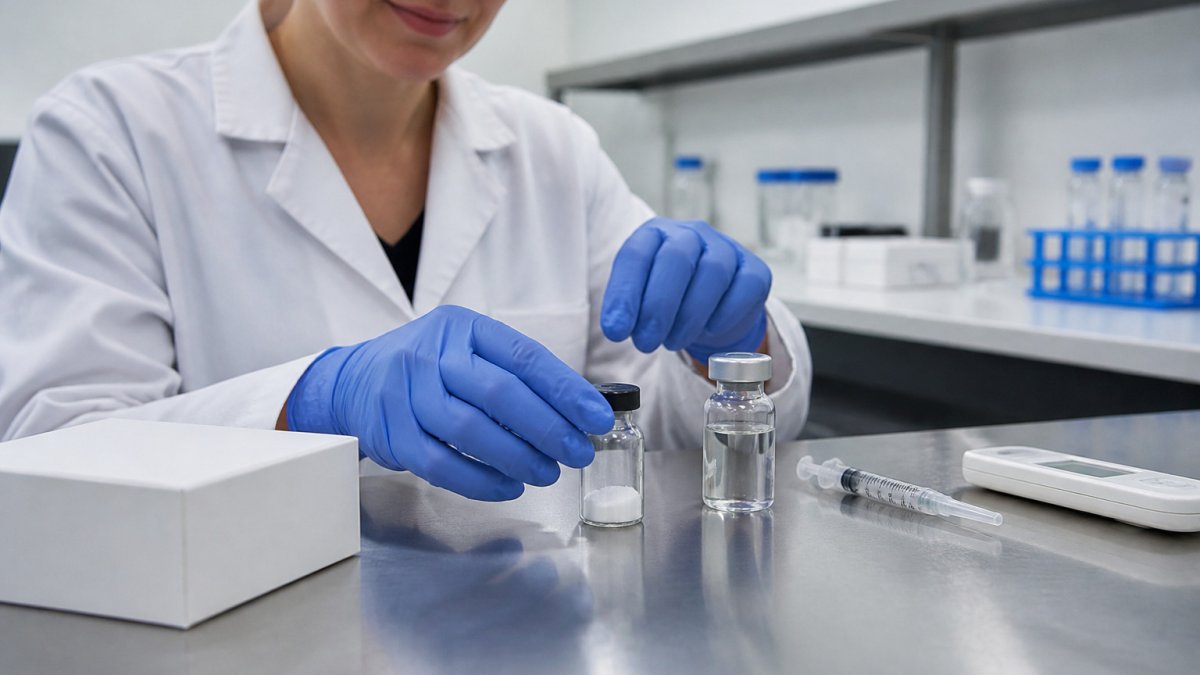
- A lyophilised GLOW 70mg vial, kept at its original storage condition until use
- Bacteriostatic water (BAC water) as the diluent, sourced from a reputable supplier
- Sterile syringes of an appropriate size for accurate measurement
- Alcohol swabs for cleaning vial stoppers
- A clean, uncluttered workspace
- A labelled container or vial for the reconstituted solution
- A thermometer for checking refrigerator temperature
Work in a clean area and wash your hands before handling anything. Contamination is a common and avoidable source of error.
How to Reconstitute Peptides in the GLOW Vial
Reconstitution turns the dry lyophilised powder into a usable solution. Because GLOW is a three-component blend, the ratio you choose affects how each peptide behaves in solution. Always check the supplier’s product documentation for the batch you hold before selecting a volume.
Step-by-step procedure
- Let the vial reach room temperature gently before opening. Condensation on a cold stopper can introduce moisture.
- Wipe the rubber stopper with an alcohol swab and let it dry fully. Do not fan it or blow on it.
- Draw the diluent slowly into a sterile syringe. Use a syringe size that lets you measure the target volume accurately, a 1 ml syringe for volumes under 1 ml, a 3 ml or 5 ml syringe for larger volumes.
- Inject the liquid down the inside wall of the vial, not directly onto the powder. Aiming at the glass wall reduces mechanical stress on the peptide cake.
- Swirl the vial gently in a circular motion. Do not shake it. Shaking creates shear forces that can denature peptide structure and generate foam that makes full dissolution harder to confirm.
- Check that the powder has fully dissolved before use. Hold the vial against a dark background under good light. A faint haze or a few particles may persist briefly; if visible particles remain after several minutes of gentle swirling, stop and query the supplier rather than assuming the vial is ready.
Calculating dilution and concentration
Record the volume added and the calculated concentration on the label. Accurate records make later experiments easier to reproduce. The general relationship is:
- Concentration (mg/ml) = total peptide mass (mg) ÷ volume of diluent added (ml)
The general relationship is applied to the total peptide mass of the vial. Confirm any figures against your batch documentation before relying on them.
Formulation differences matter
Blends sold under similar names may differ in ingredients and fill volume. Where the label or COA is unclear, confirm the reconstitution volume before use.
This procedure is written for laboratory research use only. It is not clinical instruction and must not be used to prepare any substance for administration to humans or animals.
Supplies checklist
- A lyophilised GLOW 70mg vial, kept at its original storage condition until use
- Bacteriostatic water (BAC water) as the diluent, sourced from a reputable supplier
- Sterile syringes of an appropriate size for accurate measurement
- Alcohol swabs for cleaning vial stoppers
- A clean, uncluttered workspace
- A labelled container or vial for the reconstituted solution
- A thermometer for checking refrigerator temperature
Work in a clean area and wash your hands before handling anything. Contamination is a common and avoidable source of error.
How to Store Reconstituted Peptides Safely
Once reconstituted, the solution is far less stable than the dry powder. Refrigeration is a common recommendation for reconstituted peptides once a vial is opened. Keep reconstituted peptides in a refrigerator at a steady 2 to 8°C, away from the freezer compartment and the door, where temperatures swing most. Use a thermometer to verify the actual internal temperature rather than trusting the dial setting.
Protect the vial from light by storing it in its original carton or a dark container. Label every vial with the date of reconstitution, the concentration and the contents. A common mistake is leaving reconstituted peptides at room temperature during long working sessions. Return the vial to the refrigerator between uses.
What the evidence does and does not tell us
Published stability data for multi-component peptide blends is limited, and product-specific shelf-life testing varies between formulations. Distinguish between:
- Product-specific data, stability information supplied with the batch you hold.
- General guidance, widely used storage advice for reconstituted peptides, which does not guarantee a specific expiry date for your vial.
Where reliable data is unavailable, do not invent an expiry date. Record the reconstitution date, monitor the solution for visible change (cloudiness, discolouration, particles) and treat any change as a reason to discard.
When storage conditions are uncertain: a decision guide
Use the following guide when something is unclear.
- Compromised seal or stopper, if the rubber stopper is torn, the crimp is loose or the vial was dropped, do not use it. A compromised seal means sterility can no longer be assumed.
- Temperature excursion, if the vial was left out of the refrigerator, note the duration and the ambient temperature. Short excursions may be tolerable for some formulations; prolonged exposure to warm conditions is not. Where the product documentation does not specify tolerance, treat the vial as compromised for critical work.
- Unclear or missing label, if you cannot confirm the contents, concentration or reconstitution date, do not use the vial in an experiment where traceability matters. Relabel immediately if the information is recoverable from your log.
- Visible contamination, cloudiness, discolouration, particles or an unusual odour are reasons to discard. Do not attempt to filter or rescue a suspect vial.
When in doubt, discard. A replacement vial is cheaper than an experiment compromised by an uncertain starting material.
Safe handling and disposal
Handle reconstituted vials with appropriate personal protective equipment, gloves and eye protection at minimum, and work in a clean, well-ventilated area. Where sharps are used, dispose of needles and syringes in a designated sharps container in line with local waste guidance. Do not pour peptide solutions down the sink; follow your institution’s chemical and biological waste procedures. Keep vials out of reach of unauthorised personnel and store them separately from any material intended for human or animal use.
All peptide products supplied are for laboratory research use only. They are not medicines and must not be used for diagnostic, therapeutic or any in vivo purpose.
The table below sets out the main storage points for reconstituted peptides, as covered in this section.
| Factor | Guidance | Note |
|---|---|---|
| Refrigerator temperature | 2 to 8°C | Keep away from freezer and door |
| Light protection | Original carton or dark container | Protects the vial from light |
| Labelling | Date, concentration, contents | Record reconstitution date |
| Room temperature | Return to fridge between uses | Avoid long working sessions out of cold |
| Visible change | Cloudiness, discolouration, particles | Treat as a reason to discard |
| Expiry date | Do not invent one | Use product-specific data where available |
Peptide Stability and Freeze-Thaw Cycles
Repeated freezing and thawing can affect many peptides. Divide the reconstituted solution into single-use aliquots where possible, so the main vial is not repeatedly exposed to temperature changes.
Storage requirements should follow the product specification and the supplier’s documentation.
Reading a Research Peptide Certificate of Analysis
A Certificate of Analysis (COA) records what testing confirmed about a specific batch. For a multi-component blend such as GLOW, a useful COA should confirm identity, purity and quantity for each component, not just the blend as a whole.
Look for the batch number, the testing method, the results for each peptide and the date of analysis. Compare the batch number on the COA with the one on your vial. A mismatch is a reason to stop and query the supplier.
Labelling, Handling and Next Steps for Your Lab Stock
Consistent labelling protects research integrity. Each vial should show the product name, batch number, reconstitution date, concentration and storage conditions. Keep a simple log of when vials are opened, moved and used.
Common storage mistakes include:
- Leaving vials unlabelled or with incomplete information
- Storing reconstituted solution at room temperature
- Shaking the vial to speed up dissolution
- Repeatedly freezing and thawing the same vial
- Ignoring the batch number on the COA
Avoiding these five mistakes protects the investment in your research and the reliability of your data. For current GLOW 70mg stock and specifications, visit the GLOW 70mg product page on the Research Peptides and Laboratory Products website, or contact the team for a quote. Pricing depends on quantity and delivery requirements. Peptides are supplied strictly for laboratory research use.
Frequently Asked Questions
How to store reconstituted peptides?
Reconstituted peptides should be kept refrigerated at 2-8°C, protected from light and sealed to limit contamination. Label the vial with the reconstitution date and concentration, and avoid leaving it at room temperature for extended periods. Stability varies by compound and formulation, so check the batch documentation supplied with your product and follow your protocol’s storage guidance for research use.
How much BAC water for 70mg GLOW peptide?
The appropriate volume of bacteriostatic water depends on the target concentration your protocol requires, not on a fixed recommendation. Calculate the concentration you need before adding diluent, and record the volume used. Check the product specification and your own protocol to confirm the figure, and keep a written calculation with the batch record for traceability.
What information should a peptide batch record include?
A batch record should include the product name, batch or lot number, supplier, date received, storage conditions, reconstitution date, diluent used and its volume, and calculated concentration. Retain the certificate of analysis alongside it. Consistent records help you trace variation in results back to a specific batch, which supports reproducible research.
